

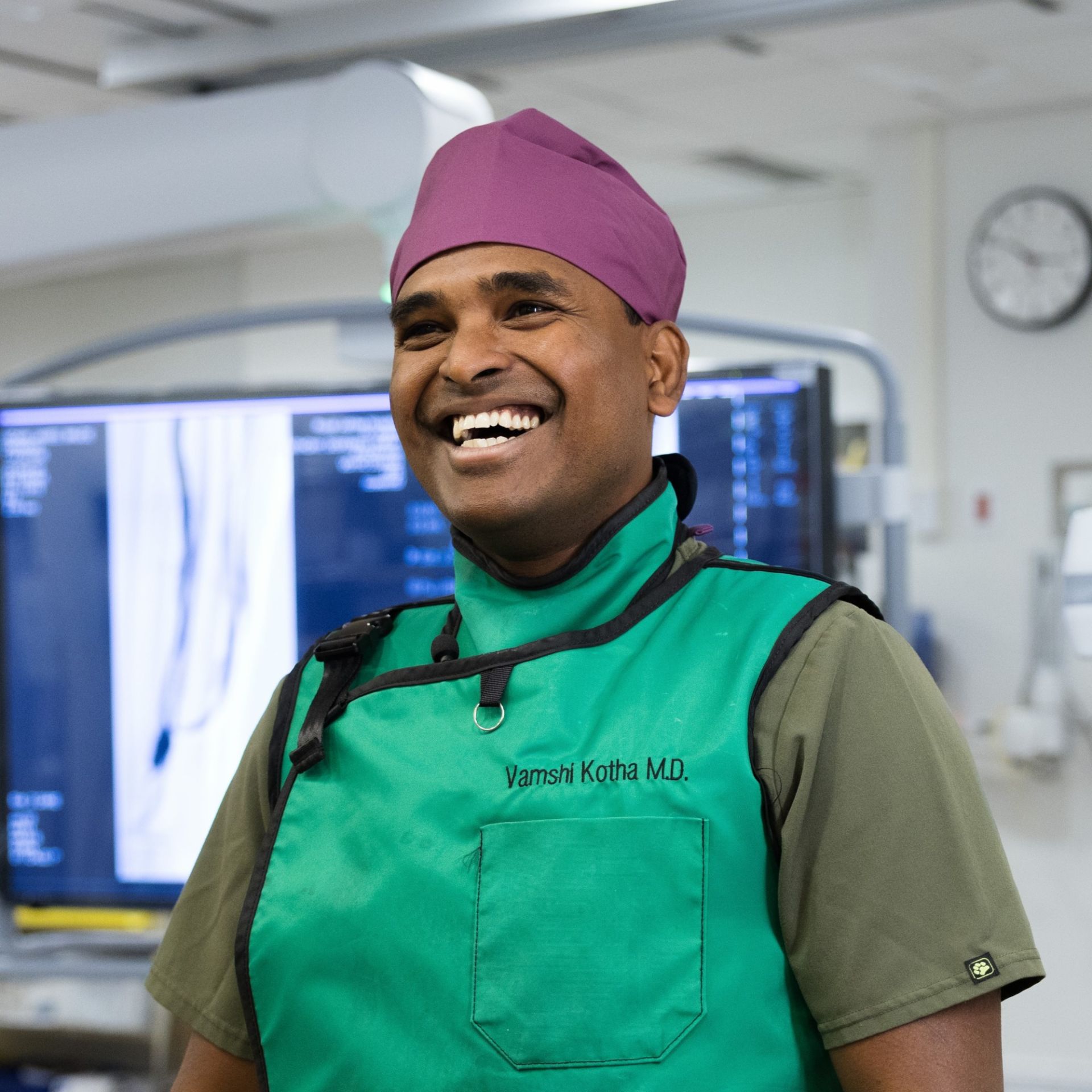
 Dr. Vamshi Kotha is an Interventional Radiologist, the Division Lead of Interventional Radiology for Island Health, and Island Health’s Medical Director of Research and Innovation. Having trained in India, completed fellowships in Toronto and Calgary, and practiced in Alberta and Saskatchewan before moving to British Columbia in 2022, he brings a broad perspective on healthcare delivery, a deep commitment to quality improvement, and a passion for research and innovation. He is also an active member of local physician groups working to strengthen interdisciplinary collaboration and has contributed to more than 20 publications through his clinical research.
What is Interventional Radiology?
Interventional Radiology (IR) is really about using imaging to see inside the body and then using that imaging to treat disease from the inside.
The imaging, like X-ray or ultrasound or a CT scan becomes our roadmap. With the help of these images, we can enter through a blood vessel in the wrist or groin, or through a tiny opening in the skin, and guide very small instruments exactly where they need to go, like using a GPS.
With IR, we can open a blocked blood vessel. We can stop internal bleeding. We can travel up into the brain and remove a clot causing a stroke. We can put a needle directly into a tumour and treat the cancer there.
For our patient, the difference can be day and night. Something that may once have required a major operation, a general anesthetic and several days in hospital can sometimes be done through an opening only a few millimetres wide as a day procedure.
You have described Interventional Radiology as “surgery through a pinprick.” What do you mean by that?
That is probably the simplest way to describe what we do.
If you think about traditional surgery, you often have to make an incision to physically reach and visualize the problem to treat it. In IR, we use imaging to get there from inside the body. Sometimes the opening we make is so small that when we’re finished, all the patient needs is a Band-Aid. But we’re still treating very serious conditions, only through that tiny opening. We might be stopping someone from bleeding internally, restoring blood flow to the brain or destroying a cancer.
That’s what is so remarkable about this field. The treatment can be incredibly sophisticated, but the impact on the patient’s body can be much smaller.
It does not replace surgery—there will always be a need for surgery—but it does offer minimally invasive treatment options when there aren’t any, or when it makes the most sense, freeing up surgical capacity for other patients.
When you think about how quickly Interventional Radiology is changing, what strikes you most?
Honestly, some of it feels like medicine in Star Trek.
Think about what we’re doing: Someone comes in having a stroke, and we can put a catheter into an artery, navigate all the way through the blood vessels into the brain, grab the clot and pull it out. You’d think this might take hours; it can be as quick as 8 minutes.
Someone has a tumour, and we can guide a needle directly into it and freeze it, burn it or electrocute it. You’d think this would be very traumatic with a long recovery; most patients go home the same evening, many with a prescription for Tylenol.
Someone is bleeding internally, and rather than making a large incision to find where the blood is coming from, we can navigate through the blood vessels, find the exact source and stop it from inside.
That’s incredible medicine, and the field is moving so quickly. Some of what we’re doing today wasn’t available when I trained in medical school. The term Interventional Radiology was in its nascency.
So I’m always thinking: What are we going to be doing five years from now that we can’t do today? That’s why we need to build for where medicine is going, not just where it is now. How can Interventional Radiology change the experience of care for patients? For me, that’s really the point of all of this.
It’s not about doing something through a smaller opening just because we can. It’s about asking: can we treat this patient effectively while putting them through less?
I think about one patient we’ve cared for who developed three separate cancers.
When you hear that, you think about what that person has already been through. You don’t want every new cancer to automatically mean another major operation, another hospital stay and another long recovery if there is another way to treat it.
With IR, we can use imaging to go directly to the tumour and treat the cancer right there, while trying to preserve as much normal tissue around it as possible.
That is what I love about this field. We can be very aggressive with the disease and very gentle with the patient.
The cancer isn’t less serious. The treatment is still serious. Science just found a way to reduce what the patient has to go through to receive it.
And when you’re treating somebody who has already been through cancer once, twice, three times, that really matters.
What could Phase III mean for the future of Interventional Radiology on Vancouver Island?
We already have a very advanced and diverse Interventional Radiology program here. We certainly have the team and the expertise. What we need now is the capacity and the environment around it. We need the innovation and infrastructure to propel us to the next decade where many more new exciting therapies are going to become available.
Right now, there are limits to how many patients we can treat and how quickly we can respond, particularly when emergencies happen at the same time. And emergencies don’t arrive one at a time. Stroke doesn’t wait because we’re already treating somebody. Trauma doesn’t wait. Internal bleeding doesn’t wait. We’ve lived that reality. We’ve had two patients arrive essentially at the same time who both urgently needed us. Both patients need you. Both patients need you now.
That’s why capacity matters. The new and modernized suites give us more advanced imaging, but they also give us redundancy. They allow us to be ready when there is another emergency happening at the same time.
And then there is the future. This field is changing incredibly quickly, and I want us to build an environment that allows us to keep changing what is possible for patients for years to come. The futuristic IR suites will set us up to use the latest technology and leverage the power of AI to improve care, making us faster and safer and laying the groundwork for bringing more and more IR therapies to the Island.
How will dedicated Interventional Radiology suites transform stroke care?
With certain strokes, there is a clot blocking blood flow to part of the brain.
Using real-time imaging, we can enter an artery, navigate a catheter through the body’s blood vessels all the way to the clot and physically remove it.
When we say “time is brain,” we mean it very literally. The longer the brain is without blood flow, the greater the potential for permanent damage, so every minute matters.
We have had two women arrive at virtually the same time, both having strokes, both needing an urgent intervention. That’s a very difficult situation because both patients need you, and both patients need you now. You never want the limitation to be that you only have one room available.
That’s what these new suites change. Yes, the imaging will be significantly more advanced, and that matters enormously. But so does simply having the capacity to respond when two emergencies happen at once.
You don’t build that capacity only for the first patient. You build it because eventually there will be a second patient who needs you at exactly the same time.
How will dedicated Interventional Radiology suites transform cancer care?
Cancer is one of the areas where IR is becoming really exciting. I sometimes explain it very simply: we can travel to a tumour and freeze it, burn it or zap it.
We use imaging to see exactly where the tumour is, guide a needle directly into it and treat the cancer right there. Depending on the type and location of the tumour, we can use extreme cold, heat or other forms of energy to destroy it while trying to preserve the healthy tissue around it. For selected patients, this can allow us to treat a serious cancer without a major operation.
The patient I mentioned who developed three cancers is a really good example of why that matters. Cancer isn’t always one event in someone’s life. Unfortunately, some patients come back to us with another tumour or another cancer. And every time we treat them, we have to think not only about getting rid of the disease, but about what that treatment is going to take out of the patient.
If we can treat the cancer effectively without putting them through another major operation, that’s a big deal.
NanoKnife technology is another example. Our hospitals were the first in Canada’s public health-care system to use the technology for early-stage prostate cancer, providing a minimally invasive treatment option for selected patients. Our first patient had no other treatment options. He went home within a day, and is now cancer-free. That’s pretty extraordinary.
Why should our community be excited about this phase, It’s Time for Surgical Transformation?
The expertise is already here. We have really good physicians, we have incredible nurses, technologists and clinical teams. We’re already doing advanced work in stroke, cancer, trauma and internal bleeding.
We are becoming one of Canada’s leading centres for Interventional Radiology, and I genuinely believe we can continue to push this field, here in Victoria.
That’s also why philanthropy matters so much. Our donors give us the ability to ask a different question. Not just, “What can we do with what we have?” but “What else could we do for this patient?”
Could we treat the stroke faster?
Could we treat that cancer without an operation?
Could we stop that bleeding without opening the patient up?
Could something that means several days in hospital today mean going home tomorrow?
That’s where medicine is going.
And to our donors, I would simply say thank you.
You’re giving us the ability to keep asking those questions, and increasingly, to answer them right here on Vancouver Island.