

At the 2026 Visions Gala, Rebecca shared her extraordinary story of survival, the Victoria care teams who saved her life, and the son who gave her every reason to fight. This is her story, in her own words.
“My healthcare story began on September 29, 2022. My thirtieth birthday. I was living in Nanaimo with my beautiful four-year-old son, Hudson, and I was in school to become a nurse.
I had not been feeling well. I was dizzy. Light-headed. Sometimes when I stood up, everything would start to go black. One afternoon, Hudson came into my room and asked, “Mommy, can you turn on my bedroom light?” That is the last thing I remember.
The next thing I remember is my dad picking me up from the bathroom floor. At the hospital, my blood pressure was alarmingly low: 68 over 42. But I was awake. I was talking. I had no idea how sick I was.
A CT scan eventually showed that I had Takayasu arteritis, sometimes called the pulseless disease. It is a rare autoimmune disease that attacks the body’s major blood vessels. Essentially, my blood vessels were shutting down, cutting off blood flow to my brain and my arms. The emergency physician told me, “I’m worried about you. At this point, I don’t think you’re going to live unless we intervene now.” Their greatest fear was that I would have a stroke.
All I could think about was Hudson. He was four years old. I remember thinking, “I can’t die. I’m his mom. He needs me. I need to get home to my little chicken nugget.”
The next day, I was flown from the Emergency Department of Nanaimo to Vancouver and placed on stroke watch. I was told this happens, that sometimes patients get sent to Vancouver when in reality, our hospitals down in Victoria are much more progressive. My parents and Hudson were at the ferry terminal when the helicopter flew overhead. I was told Hudson pointed up and said, “That’s my mommy.”
The team in Vancouver took the traditional approach of waiting and watching, and treating medically. After a week of treatment, I was discharged and flown back home, back to the Island.
But despite medications, I was getting worse. My rheumatologist, Dr. Baldwin, knew I needed something more aggressive than medications, that I needed a team that might not take the traditional approach of Vancouver, but rather look at my case through a different lens and consider a more innovative approach. I assumed that would mean going somewhere else, but that expertise, that innovation, was actually right here in Victoria.
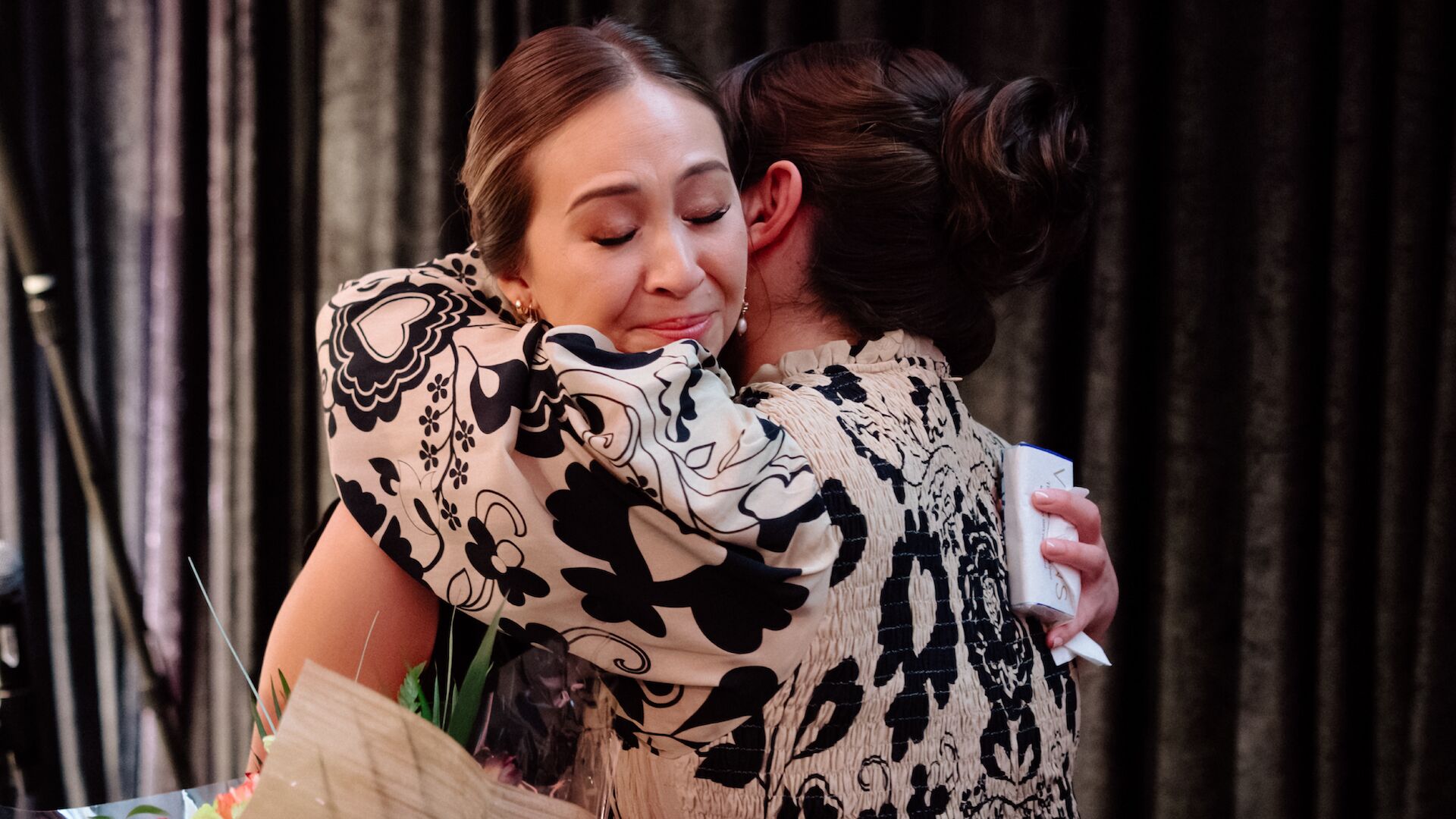
I thank every lucky star that Dr. Matt Robinson, Head of Vascular Surgery at Royal Jubilee Hospital, became my surgeon.
Matt is my hero. And I know he will not love hearing that. He will tell you it was the team. He will name every person in the room before he ever names himself. And he is right. It was an extraordinary team. But he is still my hero. He is the reason I am standing here in front of you tonight.
From that point on, Matt was with me every step of the way. There were so many pieces to my care. Rheumatology was giving me the medications I needed to control the disease, while Matt was watching what it was doing to my blood vessels and figuring out what we would need to do next. He treated me like a person. A mother. A nursing student. Someone who was frightened, but who desperately wanted to live.
That December, a scan showed that my left carotid artery was completely blocked and my right only had 3% unobstructed. It was a miracle I was still alive. I needed major surgery, but my blood vessels were too inflamed. That was when Interventional Radiology stepped in.
I underwent a novel procedure with a special balloon putting medication directly to open both carotid arteries in my neck. This balloon is usually used in the leg, but the team here innovated. Less than 20 people in the world had undergone this.
Only a nursing student would say this, but honestly, I thought it was fascinating to watch the doctors and the team doing this coordinated dance around me.
Interventional Radiology bought me time. Time to get the disease under control. Time to get stronger. Time to get back to Hudson.
I made it through another semester of nursing school, but then, in the summer of 2023, the entire left side of my body went numb. I called Matt’s office. He had always said to me, “If you were my little sister, this is what I would recommend.” This time, he said, “Rebecca, now is the time.”
I knew exactly what he meant. We were no longer trying to buy time. We were trying to save my life.
My blood vessels could no longer get enough blood to my brain and my arms. Matt would have to create new pathways around the vessels my disease had damaged. And because of how complex my case was, Matt would need a cardiac surgeon beside him. Dr. Kenny Kumar. It was now or never.
Saying goodbye to Hudson was actually the easiest thing I did, because everything in me knew Matt and his team would save my life.
When I entered the operating room, Matt needed to complete the safety checklist. He asked me my name. I said, “No.” He asked me why we were there. I said, “I don’t know.” It is like everything became real in that moment. Matt told me everything would be okay.
And I thought: medically speaking, I am yours. I surrender. Whatever you need to do, I am okay with it, because I know I am in the best possible hands.
One of the nurses held my hand while I sobbed. And then the lights went out. My heart was quite literally in the surgeons’ hands.
I woke up days later in the Cardiovascular Unit. I don’t remember much from those first days. But I remember hearing Matt’s footsteps before I could see him. I knew it was him. And I started crying before he even opened the curtain.
Recovery was hard. I could not do the most basic things for myself. And all I wanted was to get home to Hudson. But if I was going to be his mom again in the way I wanted to be, I had to learn how to do all of those basic things again first. So I did.
And I was surrounded by people who never saw me simply as a diagnosis.
Nurses Megan and Christina. Francesca. Jamie, who put on enormous men’s gumboots so she could help me shower. An Indigenous liaison nurse who came and braided my hair. Dr. Kenny Kumar. Dr. Matt Robinson. Elder Mark Atleo, who held a beautiful healing ceremony for me. My mom Sue, my dad Bob, my brother Donald. And so many others whose names I may never know.
They saw me at my most vulnerable. They cared for me when I could not care for myself. There are no words, and there is no amount of gratitude, that could ever fully express what I feel for every person on my care team.
That September, I returned to nursing school. I asked to complete a placement on the same post-surgical unit where I had recovered. I wanted to stand on the other side of the bed.
People sometimes tell me I am a hero for everything I have survived. But I am not. The heroes are the physicians, the nurses and every person who stood around me and refused to give up.
Before my surgery, I used to say, “I would die for my child.” Somewhere along the way, that changed. Now I say that I fight every single day to live for him.
And I also know how precious life is. My dad was supposed to be my plus-one tonight. He passed away in his sleep just a few weeks ago.
When I met with Gaëlle, the angel from the Foundation team who helps all of us share our stories, she told me I did not have to do this tonight. And for a moment, I didn’t know if I could. But my dad knew I was going to tell this story. He knew what this team had done for me. And I know he would be proud that I am standing here.
My dad was there from the beginning. He picked me up from the bathroom floor. He sat beside me in the hospital. He made sure Hudson and I had a home. My dad always showed up for me. He should be here tonight, and in every way that matters, he is.
I am glad that, while I lost him, he never lost me.
Today, my disease is in remission. I don’t know exactly what the future will hold. But I am alive. I finished nursing school. I am raising my son. I am caring for my community as a nurse in Port Alberni. And every day, I get to live the life that this extraordinary team fought to give back to me.
Life is so precious. Thank you for helping our physicians, nurses and care teams protect it.
Dad, Hudson, Matt: the three men who, each in their own way, carried me through the fight of my life. This one is for you.”
Rebecca
Grateful Patient