

$43 Million Campaign Launched for Stroke, Cardiac, and Cancer Care Excellence
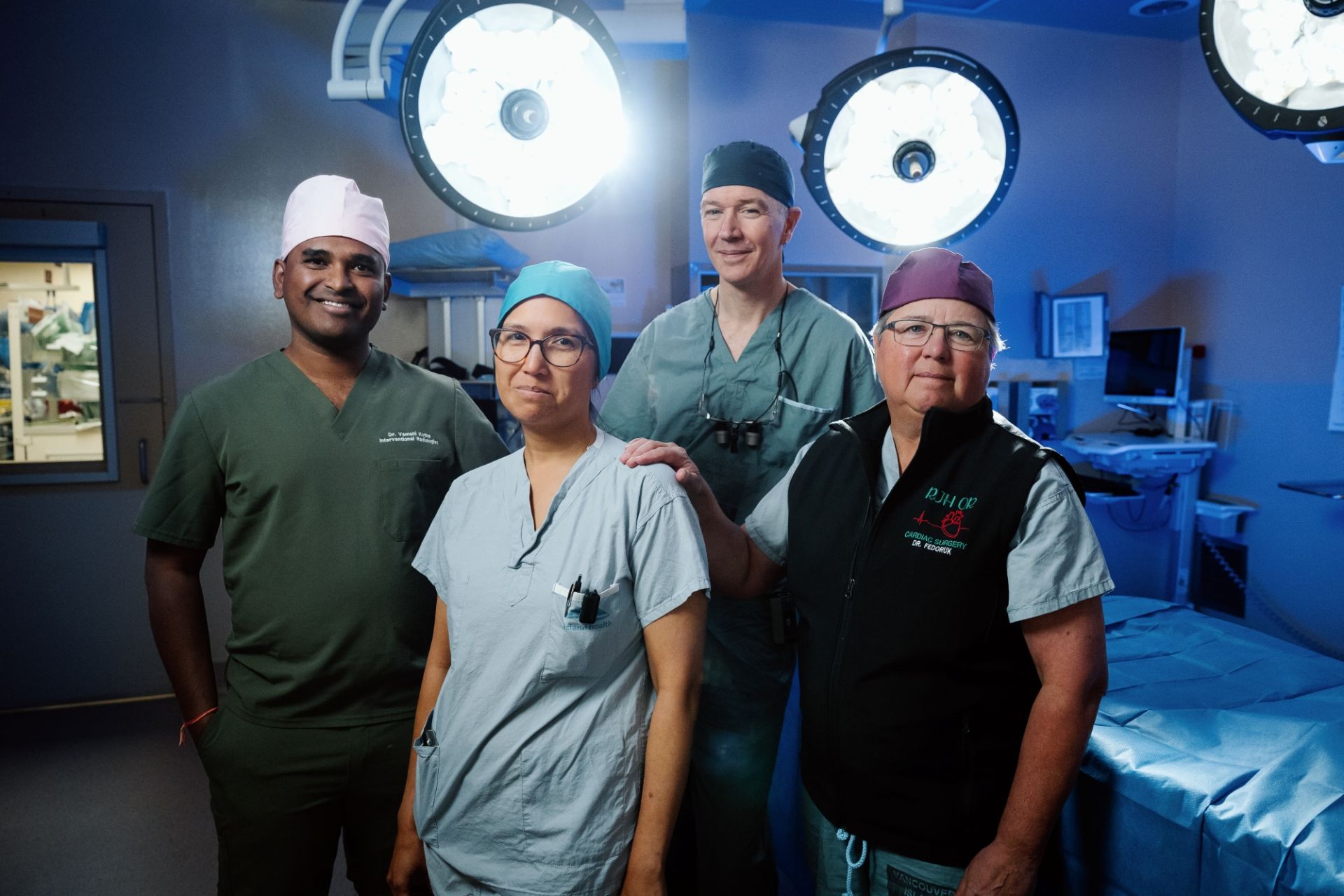
Left to Right: Dr. Vamshi Kotha, Head of Interventional Radiology; Dr. Nadra Ginting, Chief of Surgery, RJH; Dr. Matt Robinson, Head of Vascular Surgery; Dr. Lynn Fedoruk, Head of Cardiac Surgery
Victoria, BC — What if a stroke-causing clot could be removed before it takes away a person’s ability to walk, speak or recognize the people they love? What if a cancer considered inoperable did not have to be untreatable? What if advanced imaging, minimally invasive intervention and surgery could come together in one room, around one patient, when every moment and every millimetre matter?
Today, those possibilities move closer to reality on Vancouver Island. The Victoria Hospitals Foundation (VHF) has launched Phase III: It’s Time for Surgical Transformation, a bold $43-million campaign that will build Vancouver Island’s first two Hybrid Operating Rooms and double Interventional Radiology capacity at Royal Jubilee (RJH) and Victoria General (VGH) hospitals.
The third and culminating phase of the Foundation’s multi-year It’s Time campaign, Phase III responds to one of the defining healthcare challenges of our time: meeting the needs of a growing and aging population, including one of the oldest populations in Canada, with the number of residents aged 85 and older projected to more than double over the next 20 years, while creating the advanced environments needed to transform how some of the Island’s most complex and time-sensitive conditions are treated. These investments will expand capacity, advance innovation, and elevate the level of tertiary care available for stroke, cancer, cardiac and vascular disease at RJH and VGH, which offer the highest levels of specialized treatment for Islanders.
“This campaign is about a remarkable opportunity for Vancouver Island. Our population is aging and growing rapidly, demand for specialized care has never been greater, and a new era of medicine is unfolding before us. Rather than simply keeping pace, we have an opportunity to lead the future of specialized care in British Columbia, and we are seizing it,” says Avery Brohman, CEO, Victoria Hospitals Foundation. “We are fortunate to have physicians and care teams who are already leading national innovation in Interventional Radiology, Vascular Surgery and Cardiac Surgery, and whose vision is to expand capacity, introduce new possibilities in patient care, and build one of the most advanced surgical and interventional care platforms in the country. Philanthropy is what makes that future possible.”
Impact: Doubling Interventional Radiology Capacity ($17.6M)
Phase III will help establish one of the most advanced Interventional Radiology platforms in Canada and accelerate a new era of technology-enabled precision medicine on Vancouver Island.
Using advanced imaging as a real-time roadmap inside the body, Interventional Radiologists can navigate directly to the source of disease through a patient’s veins and arteries, and deliver treatment with extraordinary precision. They can remove stroke-causing clots from the brain, stop life-threatening internal bleeding, restore blood flow, and treat early-stage cancers, often without the need for traditional surgery.
The campaign will create two new Interventional Radiology suites, modernize two existing suites, and establish dedicated recovery space, creating a four-suite platform that will double Interventional Radiology capacity across RJH and VGH. It will also bring next-generation imaging technology capable of providing significantly more powerful visualization than what is available today.
“Interventional Radiology allows us to replace major surgery with surgery through a pinprick,” says Dr. Vamshi Kotha, Head of Interventional Radiology, RJH and VGH. “For example, through Interventional Radiology, our hospitals became the first in Canada’s public health system to use NanoKnife technology for early-stage prostate cancer, opening a new treatment pathway for patients who previously had no treatment options. This is what Interventional Radiology makes possible: technology-enabled, precision medicine that expands what we can offer patients while positioning our hospitals at the forefront of a rapidly evolving field.”
The expansion will increase access to advanced stroke and early-cancer treatments, preserve valuable operating room capacity, and help more patients recover sooner and return home faster. By establishing two suites at each site, the program will also create critical redundancy, ensuring our care teams can respond when multiple urgent cases arise simultaneously, including situations where two stroke patients require life-saving intervention at the same time.
Impact: Building The Island’s First Two Hybrid Operating Rooms ($25.4M)
Phase III will also deliver Vancouver Island’s first two Hybrid Operating Rooms at RJH and the first net-new operating rooms added to Victoria’s hospitals in more than 23 years. Featuring BC’s most advanced surgical imaging technology and among the first platforms of their kind in Canada, these purpose-built environments will dramatically expand capacity while supporting some of the most complex stroke, cardiac and vascular procedures performed anywhere in the country.
Hybrid Operating Rooms combine advanced robotic-assisted imaging technology and full surgical capability in a single purpose-built space, allowing our teams to diagnose, assess, intervene, and operate without ever moving the patient. Designed for patients whose conditions leave little room for delay or error, Hybrid Operating Rooms support some of the most complex procedures performed in our hospitals, including advanced aortic aneurysm repair, complex vascular reconstruction, stroke-prevention interventions, and multi-disciplinary operations lasting 12 hours or more.
“In a Hybrid Operating Room, care comes to the patient. For our most complex cases, that can mean multiple surgical teams, including surgeons, nurses, anesthesiologists, imaging technologists, perfusionists, and advanced surgical and imaging technology all working together around a single patient,” says Dr. Matt Robinson, Head of Vascular Surgery, RJH. “Hybrid Operating Rooms will support some of the most advanced procedures performed anywhere in Canada, including the country’s newest approaches to stroke prevention. Although Vancouver Island represents just 15 per cent of British Columbia’s population, our teams care for approximately 40 per cent of the province’s stroke volume. Hybrid Operating Rooms will give us the environment needed to meet that responsibility and continue advancing care for our Island patients.”
RJH is home to nationally recognized cardiac and vascular programs that already deliver some of Canada’s most sophisticated care. Last month, our Vascular Surgery team brought TCAR to Victoria, one of Canada’s newest approaches to stroke prevention, making RJH one of only three centres in the country to offer it and performing Canada’s 10th through 14 th TCAR procedures. Our Cardiac Surgery team is also envisioning minimally invasive coronary bypass procedures performed through small openings between the ribs rather than opening the breastbone.
Phase III will provide the specialized environments needed to support these innovations and the many breakthroughs still to come, attract and retain top clinical talent, expand patient access, and increase capacity in operating rooms, Diagnostic Imaging, and the Heart Catheterization and Electrophysiology Labs.
Philanthropy At The Helm
Transforming surgical care on Vancouver Island takes a community-wide effort, but the campaign is already building remarkable momentum. To date, $8.2 million has been committed toward the Foundation’s $43-million goal, including a transformational $3-million leadership gift from local philanthropist Craig Mearns, the first donor to champion Phase III. Another local philanthropist followed with a transformational $3-million contribution of her own, creating a powerful foundation for the campaign’s public launch
“One of the things I have always believed is that our physicians and care teams on Vancouver Island consistently punch above their weight,” says Craig Mearns, local philanthropist and first donor to Phase III. “They are leading innovation and taking on some of the most complex cases in the country. If we want them to continue pushing boundaries and delivering the very best care for our community, we need to give them the environments and technology to do it. It has been incredibly gratifying to see Phases I and II come to life in such a short period of time, and to see the impact of that investment in our lifetime. I am grateful to all donors who join me now in supporting Phase III.”
“This campaign is ultimately about people: our physicians who are leading innovation, our donors who make that innovation possible, and the patients whose lives depend on it,” says Avery Brohman, CEO, Victoria Hospitals Foundation. “We are deeply grateful to Craig Mearns, our early supporters, and everyone who will join them in building one of Canada’s most advanced surgical and interventional care platforms for Vancouver Island patients and families.”
In two years, through Phases I and II of It’s Time, thousands of donors helped raise $38 million to bring transformative surgical innovation to Victoria’s hospitals, including robotic-assisted surgery, advanced surgical oncology tools, and new technologies that have expanded access to specialized care for Island patients.
Now, Phase III looks beyond the technology itself to the environments where modern medicine happens, ensuring our hospitals, our caregivers, and our patients have access to the facilities required for the next generation of care.