Past Campaign: In A Heartbeat

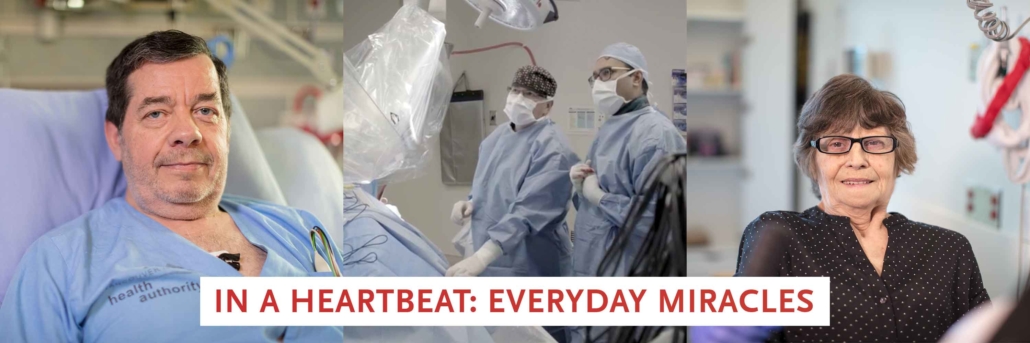
At Royal Jubilee and Victoria General hospitals, miracles happen every day. This is especially true for our cardiac patients.

Every year, over 200,000 of our community members go through a cardiac assessment at Vancouver Island hospitals, and over 6,300 cardiac procedures are performed on men and women of all ages. While many attest to the uncertainty and hardship that accompany the news of a cardiac condition, our patients take comfort in the fact they have access to a world-class cardiac program.

Over the past 30 years, the Heart Health program at Royal Jubilee Hospital has grown into a national leader and pioneer in cardiac care. The multi-disciplinary teams driving this Heart Health program have forged a culture of excellence and innovation that allows patients to quickly receive the most up-to-date procedures, recover faster and go home to their families sooner. The program has attracted physicians from around the world and turned Royal Jubilee Hospital into a referral centre for cardiac patients throughout Vancouver Island and across British Columbia.

But to perform the latest cardiac procedures, our Heart Health teams need the best equipment.

Through our Campaign for Cardiac Care, we aim to raise $3.2 million to fund 34 pieces of leading–edge equipment in seven different areas of cardiac care.


A gift to this campaign will equip our Heart Health teams with the tools they need to ensure patients have the best outcomes possible. Help miracles happen by making a gift today.

Stories

It’s a sunny July afternoon at Uplands Golf Club. The greens are freshly trimmed and the birds are singing. Like any summer’s day, the course is abuzz with enthusiastic golfers. But there’s something different about today’s round.

Today, small red hearts decorate the flag at each hole. The stakes are high and there’s money on the line, but a low score is not the primary objective. Today is the 40th Annual Uplands Golf Club Heart Tournament and the participants have only one goal: help fund lifesaving cardiac equipment for Royal Jubilee Hospital (RJH).

The Uplands Heart Tournament began in 1978 with a gathering of golfers and hockey players at Uplands Golf Club, one of Victoria’s oldest courses. After their friend spent time in the cardiac unit at Royal Jubilee Hospital, a few golfers wanted to recognize medical staff with a donation towards cardiac care.

“It started coincidentally with a hockey school being held up Island,” said long-time Uplands contributor Bruce Thom. “We were able to get some NHL stars to come down and play and we raised a few dollars.”

With a first successful fundraiser in the books, organizers decided to try again in 1979. Uplands Golf Club Captain Gordon Pellow volunteered as tournament chair, helping with everything from logistical planning to cooking lunch and washing dishes. By 1980, Uplands had established a strong partnership with Royal Jubilee’s cardiac teams and the Uplands Golf Club Annual Heart Tournament was born.

In 1990, Bruce Thom took over as tournament chair ― a role he held for the next 15 years. To increase participation and fundraising potential, the Heart Tournament instituted an entry fee for golfers and added a women’s tournament. Eventually, Uplands started accepting business sponsorships and proceeds began to eclipse $100,000 annually for cardiac equipment.

“It really is about the community coming together for a great cause,” says Thom. “Uplands generously donates the course, businesses sponsor the event and golfers rally to support an area of care that has affected them or their family in one way or another. It’s very special.”

Now in its 40th year, the Uplands Heart Tournament is British Columbian’s longest-running charity golf event, raising more than $2.6 million for Heart Health on Vancouver Island. The tournament draws a range of participants, donors, volunteers and business partners from throughout the community.

“I think like any organization, Uplands’ greatest assets are its people. They have a very strong community spirit,” said John Martin, another past chair for the Heart Tournament. “We get tremendous support from our members and through them we gain support from the community as a whole including many individual donors as well as prominent businesses, professionals and members of the medical community. A number of doctors and surgeons golf in the tournament but many are contributors even if they don’t golf.”

John Martin first got involved with the Heart Tournament 10 years ago. An avid golfer, John had a family history of heart disease and believed it was important to support local cardiac services. That belief grew even stronger in 2013 when John checked into Royal Jubilee Hospital with chest pain.

“When you have a heart attack, you’re suddenly confronted with something that you have no experience with and know relatively little about. You have some serious questions.” said John. “What was amazing to me was the absolute competence and care that was conveyed by all of the medical staff, from the nurses in the cardiac care unit to the surgeons and the operating room nurses. Everybody had their role and everybody was so good at taking charge and communicating that you felt immediately comfortable knowing you could have confidence in them.”

Over the years, this event has funded urgently needed medical tools for almost every area of cardiac care, including telemetry monitoring systems, pacemakers, cell savers and critical care beds. The 2017 men’s and women’s tournaments, held on July 19 and 23, raised $160,000 for a new heart catheterization laboratory C-arm. Funds from the tournament supported the Victoria Hospitals Foundation’s ongoing Campaign for Cardiac Care.

“Royal Jubilee Hospital has one of the top rated cardiac programs in North America and it’s vital that we have the latest equipment for diagnosis, intervention and rehabilitation,” said Dr. Lynn Fedoruk, Division Chief of Cardiac Surgery at Royal Jubilee. “On a daily basis, I find myself conducting lifesaving procedures with equipment that was in my hands thanks to generous community donors like the Uplands Heart Tournament.”

Two of the tournament’s most faithful supporters are Don and Marni Bold, whose involvement stretches back 38 years. The Bolds first donated five cases of hamburger patties towards the tournament luncheon in 1980 and have since supported a number of important cardiac initiatives through Uplands. The couple had a scare in 2012 when Marni suffered a heart attack.

“For us, the Heart Tournament means this right here,” said Don, patting Marni’s hand and blinking away tears. “If it’s good for all of us, it’s good for me. We plan to support the heart fund till we’re pushing up daisies!”

Organisers are already looking forward to next year. Few charitable events in B.C. have achieved the longevity of the Uplands Golf Club Annual Heart Tournament, and for John Martin, this success boils down to one important factor.

“When I got involved it was by our definition a grassroots tournament, meaning that it was community members doing things they thought were important to people in Victoria and on the Island,” said John. “I think that is the driving force behind this tournament. It’s the notion that collectively we can do more together than we could ever hope to accomplish individually. I think that’s really been the spark of whatever success we’ve had. We have this world-class facility right here in Victoria and we see a strong responsibility to try and maintain it and help make it even better. One way or another heart incidences affect everyone in a community and this gives us a way to pay forward the benefits we received.”

Every year, more than 200,000 people on Vancouver Island receive a cardiac assessment at one of our Island hospitals, and over 6,300 cardiac procedures are performed on men and women of all ages. While many attest to the uncertainty and hardship that accompany the news of a cardiac condition, patients take comfort in knowing they have access to a world-class cardiac program. Through our Campaign for Cardiac Care, In a Heartbeat: Everyday Miracles, we aim to raise $3.2 million to fund 34 pieces of leading–edge equipment in seven different areas of cardiac care.
“A life well-lived is perhaps the greatest art of all.”

—Iain McCaig

Iain McCaig is a renowned artist and storyteller. Known in eons past for a certain Jethro Tull album cover, these days he is responsible for helping create movie icons like Darth Maul, Rocket Raccoon, Groot, the Hulk, Mad Eyed Moody, Mowgli and more. Yet he always returns to his beloved Victoria for inspiration: the place where he first found a crayon and a flat surface and began to draw.

“I remember every drawing,” Iain says, “but one is especially vivid. It was a robot, and I was drawing it for Tom Hanks. Tom Hanks didn’t know this yet, because he hadn’t signed to do the movie, but the producer was hopeful, and I was happy to oblige. It was last March, three days after my 60th birthday. I never made it to the drawing board.”

On the way to his studio, Iain collapsed.  A pain in his chest knocked him flat and got worse. It was all he could do to crawl to the phone and dial 911. “I’ve never cared for the sound of sirens,” he said, “but just then they sounded like a band of Guardian Angels screaming to the rescue.”

He was rushed to Royal Jubilee Hospital where an electrocardiogram (ECG) confirmed what the doctors already knew. Iain was in the midst of a major heart attack. The vague yet persistent symptoms he had been ignoring during his morning runs and work-outs — slight pain and shortness of breath — were not the foreshadows of old age. “When you are seemingly healthy, fit, and active, not to mention unstoppably optimistic,” Iain says, “it’s easy to speed past the warning signs.”

The ECG results made it clear to the cardiac team that the cause of Iain’s heart attack was a blocked artery. He was rushed upstairs where cardiologists in the Heart Catheterization Laboratory used a C-arm to insert a balloon and stent to unblock the artery. The angioplasty procedure stopped the heart attack instantly by opening the artery and allowing blood flow to return to normal. And because Iain had reached the hospital and received rapid diagnosis and treatment, there was no lasting damage to his heart.

Cardiologist Dr. Peter Gladstone explains how timely treatment makes all the difference to people experiencing a heart attack. “The number one factor in the success of angioplasty is how quickly we are able to perform it. If a heart attack patient receives the procedure within two hours of the onset of severe pain, there is typically no lasting damage to the heart muscle. The sophisticated tools in the Heart Catheterization Laboratory allow us to stop heart attacks in progress.”

When Iain woke up in the Patient Care Centre the morning after his heart attack, the first thing he asked the Nurse for was a pencil and paper. “And then I drew my producer friend his robot.” He then proceeded to give the staff sketches and art classes and added dinosaurs to his vital statistics white board. Dr. Gladstone let him go home before he started drawing on the walls.

Now home in his studio, Iain looks back on the event with an even brighter gleam in his eyes. “The epiphany was coming home and realizing that all the undone things—the stories I’ve wanted to tell and the pictures waiting to be drawn and everything else I’ve been meaning to get around to—all that vanishes with me when I go. So whatever it is you really want to do in life, do it now. This is not a dress rehearsal.” With a smile, he adds, “And watch those warning signs.  A life well-lived is perhaps the greatest art of all.”

“It’s imperative for people to check their risk factors with their doctors,” says Dr. Gladstone. “In Iain’s case, even though he led an exceptionally healthy lifestyle, he had undiagnosed elevated cholesterol which led to the blockage in his artery.”

When our hospitals have the expert teams and leading-edge tools they need to save people, potentially tragic stories become triumphant tales of survival. “A positive outcome for our patients is the ultimate goal, and having state-of-the-art equipment truly matters. Equipping our cardiac teams with the precise and sophisticated tools they need to provide the utmost in care makes all the difference in people’s lives,” says Dr. Gladstone.

Every year, more than 200,000 people on Vancouver Island receive a cardiac assessment at one of our Island hospitals, and over 6,300 cardiac procedures are performed on men and women of all ages. While many attest to the uncertainty and hardship that accompany the news of a cardiac condition, patients take comfort in knowing they have access to a world-class cardiac program. Through our Campaign for Cardiac Care, In a Heartbeat: Everyday Miracles, we aim to fund 34 pieces of leading-edge equipment in seven different areas of cardiac care by raising $3.2 million dollars.

Postscript: The science fiction film Bios is currently scheduled to begin filming in 2018.  It will star Tom Hanks. And a robot.

In 1939, 16-year-old Howard “Howie” Meeker was denied entry into the Canadian Air Force on the premise he had an unhealthy heart. No one told him what the issue was, only that his heart could not endure the physical strain of the job.

This did not stop Howie from living life to its fullest. A self-taught hockey player, he continued to skate on ponds and rivers for hours each day, and eventually became a star player for the Toronto Maple Leafs. He was 23 when he received the Calder Trophy, NHL’s top rookie honours.

Over his lifetime, Howie went on to win four Stanley Cups, a seat as Member of Parliament for Waterloo South, distinguished titles such as NHL Head Coach and General Manager, and thousands of Canadian hearts as one of the country’s favourite hockey commentators. He retired in Parksville and was inducted into the Order of Canada in 2010 as recognition for his exceptional contributions to our country.

A few years later, Howie’s life was put on hold when he was given six months to live. His doctors had detected a heart murmur and diagnosed him with aortic stenosis, a condition that makes the heart work harder to pump blood due to calcium deposits in the valves. Unfortunately, medication could not reverse the damage. The usual treatment of open heart valve surgery was not an option for Howie as his age classified him as high-risk.

Thankfully for Howie, he was referred to Dr. Anthony Della Siega at Royal Jubilee Hospital.

As an interventional cardiologist, Dr. Della Siega treats the heart through minimallyinvasive procedures. An early adopter of leading-edge cardiac treatments, Dr. Della Siega chose to work at Royal Jubilee Hospital after learning of its world-renowned Heart Health program.

After specialized cardiac testing, Dr. Della Siega knew he could give Howie a better and longer life through transcatheter aortic valve implantation (TAVI).

Performed in the heart catheterization laboratory at Royal Jubilee Hospital, the TAVI procedure is revolutionary.

It allows cardiologists like Dr. Della Siega to access the heart through a small incision in the patient’s leg and thread a catheter lightly through the artery until it reaches the diseased valve. To guide this meticulous task without perforating the artery, the team constantly monitors real-time images being taken by a C-arm, a piece of equipment that rotates around a patient’s body to capture the movement of the catheter. When the catheter is stable, a new biological valve is inserted through it.

Immediately following the procedure, Howie’s heart started working normally again. He was up and walking the very next day, feeling lighter and stronger. “What a feeling!” he remembers.

Four years later, Howie is alive and well. “I have never felt as good as I have since the TAVI and I cannot thank Dr. Della Siega and the entire Heart Health team enough for their compassion and remarkable care.”

Howie’s story is just one of many. Every year, the Heart Health team assesses over 200,000 patients on Vancouver Island and perform over 6,300 cardiac procedures. To do their best work, they need the best equipment possible.

To help our cardiac team continue to provide leading-edge care, the Victoria Hospitals Foundation has launched a $3.2 million campaign to fund 34 pieces of equipment at Royal Jubilee and Victoria General hospitals.

One of these pieces of equipment is a new heart catheterization laboratory C-arm that will replace a 10-year-old machine.  A gift toward this campaign will help give Dr. Della Siega and the Heart Health team the equipment they need to provide the very best care.

“The new C-arm is essential to our work,” says Dr. Della Siega. “The fact that we can replace a faulty valve in under an hour without having to put patients through surgery is incredible. After insertion, the new biomedical valve works within seconds of placement and allows blood to immediately flow throughout the body.”

The new C-arm will also be used in other important interventional procedures, including angioplasties and pacemaker insertions.

“The C-arm truly was critical in allowing me to do Howie’s procedure. I couldn’t have saved his life without it.”

Canadian Tire has the tools needed to fix just about anything, from leaky pipes in your kitchen to squeaky brakes in your car. But as cardiac patients at Royal Jubilee Hospital know, cars and kitchens aren’t our only possessions that sometimes require fixing.

Every December, local Canadian Tire stores organize the annual Fix-A-Heart campaign to help purchase urgently needed cardiac equipment for Royal Jubilee Hospital (RJH). Customers are asked to donate at the till and Canadian Tire stores match every gift. Now entering its fifteenth year, Fix-A-Heart has raised more than $740,000 for cardiac care on Vancouver Island.

This incredible campaign began in December 2003. At its onset, Peter Spillette, former owner of Langford’s Canadian Tire store, believed outstanding cardiac care was something we should all support. In partnership with the Victoria Hospitals Foundation, Peter launched Fix-A-Heart and soon convinced other local stores to join the cause.

When he passed away in 2008, Dave Ullathorne from the Douglas Street location stepped up as the new campaign coordinator. By that time, Fix-A-heart had already raised $300,000 and showed no signs of slowing down.

“Dave, and before him Peter, would provide us with weekly updates and challenge us to meet those goals or exceed those goals,” said Kim Reynhoudt, Associate Dealer for Canadian Tire View Royal. “If one year we were planning to raise $50,000, we would make sure we were on track to meet or beat that target. I would say most years we certainly beat the target.”

“The employees are the people who make this work,” said Dave Ullathorne, who recently retired after eight years spearheading Fix-A-Heart. “From the managers who rally the staff, to the office staff that tally who has raised the most, to all the cashiers who ask the customers for their donation. It is a team effort.”

RJH is the Heart Health referral centre for all 785,000 residents of Vancouver Island and the Gulf Island communities. The Heart Health team relies on the generosity of community donors to help keep Royal Jubilee on the leading edge of patient care.

“When our caregivers have access to the absolute best medical tools, it greatly improves the quality of care cardiac patients receive,” said Bruce Dyck, Board Chair for the Victoria Hospitals Foundation. “The level of success and longevity achieved by the Fix-A-Heart campaign is absolutely incredible and it makes a big difference for our medical teams and patients knowing they have the full support of our community.”

Over the years, Fix-A-Heart has funded a variety of important medical tools, including ECG machines that diagnose heart arrhythmias, transport monitors that help patients move safely between units and cardiac treadmills that provide non-invasive stress testing for heart health patients.

For this year’s campaign, customers can donate at the till from now until December 24 at the Hillside, View Royal and Royal Oak stores, and the Gordon Head automotive centre. The stores will match any customer donation to help fund a new state-of-the-art heart catheterization C-arm at Royal Jubilee Hospital.

The C-arm is used for a variety of important cardiac diagnoses and procedures. The C-arm allows caregivers to:

  • obtain real-time images of a patient’s heart and blood vessels by conducting a diagnostic test called an angiogram. The images show the location and size of any blockage in or near the heart and allow medical teams to determine the best life-saving approach.
  • perform an immediate procedure such as a balloon angioplasty or the insertion of a stent or a new heart valve, again using the real-time images from the C-arm to guide a physician’s meticulous tasks. With these images, doctors can unblock arteries, stop a heart attack or replace a diseased valve in a couple of hours at most.

These life-saving procedures mitigate the need for general anesthetic or open heart surgery and patients go home, in many cases, the same day.

To help fund a C-arm this holiday season, visit the Hillside, View Royal or Royal Oak Canadian Tire store, and the Gordon Head automotive centre. Together, we can fix hearts.

This year’s Fix-A-Heart Campaign supports the Victoria Hospitals Foundation’s fall Campaign for Cardiac Care, In a Heartbeat: EveryDay Miracles, which is raising $3.2 million for priority cardiac equipment at Royal Jubilee Hospital.

I am cardiologist. I am a doctor who studies and treats heart disease.

I look after the vital organ that pumps blood to all the other organs in the body. I diagnose and treat all types of heart disease – coronary artery disease, valvular heart disease, cardiac tumours, congenital heart defects and many other cardiovascular diseases. Heart disease affects everyone: the grandfather who loves to golf, young parents whose kids are in grade school and the 30-year old marathon runner.

Heart disease is serious. It is therefore critical that we diagnose and treat it as early as possible. My role on the cardiac team is to use equipment to pinpoint the problem. If I can, I will treat the illness myself. Otherwise, I quickly refer the patient to the right treatment specialist, such as an interventional cardiologist, an electrophysiologist or a cardiac surgeon. With leading-edge equipment, I am able to make a precise diagnosis and immediately get my patient the care they need.

That is why I am so grateful to be working with the Victoria Hospitals Foundation this fall to help raise $3.2 million for urgently needed cardiac equipment.

One important piece of equipment we need is a new echocardiogram ultrasound, which costs $100,000. An echocardiogram is a cardiac ultrasound that uses information from reflected sound waves to reconstruct moving images of the heart. These images show me the heart chambers and valves in fine detail. From there, I am able to detect abnormalities that, in some cases, require urgent treatment.

Our team of dedicated echocardiographers, sonographers and nurses perform and analyze around 10,000 of these echocardiograms each year for patients across Vancouver Island.

In my patient Mehmoona’s case, I found a myxoma, a large tumour in her heart that had caused her to suffer a series of small strokes. The echocardiogram allowed me to quickly find the cause of her strokes and set a course of treatment in motion. Today, she is tumour-free and is no longer at risk of any further strokes.

Mehmoona shares her story with you. I hope you find it inspiring.

Thank you,

Dr. Karan Shetty
Cardiologist
Island Health

Life is fragile. That realization is never stronger than when you have an unexpected scare with your health. For me, this came with the diagnosis of a tumour growing on my heart. I was terrified and confused. Thankfully, I learned that we have world-class cardiac care right here on Vancouver Island.

Three months ago, I was living a healthy life, hiking with my husband and prepping for a new semester at the University of Victoria where I teach social work. But one afternoon, as I went to move my arm, my body stopped responding. We went to Emergency and within the hour I was diagnosed as having had a stroke.

From that moment on, I had an entire team of people looking after me. They had a profound desire to make me feel safe and help me understand what would happen next. There would be blood tests, an electrocardiogram of my heart and an MRI of my brain to pinpoint the cause of the stroke and its prognosis. The tests showed I had had eight consecutive mini strokes. I was very lucky to not yet have any permanent damage that would impact my quality of life.

Since the first set of tests did not show any blood clots, I went in for an echocardiogram to find the source of the strokes.  A specialized technician was taking images of my heart when I noticed a change in his demeanour. As a social work expert, I read people well and I knew he had seen something unusual on the screen. I went straight to my husband and told him, “Farouk, there is something wrong with me.”

That’s when I met Dr. Shetty. He sat my husband and I down and told us about the myxoma on my heart, a 2cm x 2cm tumour that was clearly visable on the echocardiogram. He explained that while the tumour was most likely benign: small portions of it were breaking off into my bloodstream, causing strokes. “Time is ticking,” he said.

It was a lot to take in and we had so many questions. Thankfully, Dr. Shetty had answers. I was to have surgery in the next couple of days and he explained the process step-by-step. First, I would have an angiogram of the heart to ensure the rest of it was healthy, then Dr. Bozinovski would perform a 4-hour procedure to remove the tumour, followed by a short stay in Royal Jubilee Hospital’s Cardiovascular Intensive Care Unit. A specialized rehabilitation program would begin eight weeks later. I was amazed by how seamlessly all the different cardiac teams worked together. I was so reassured by that.

Everything went exactly as planned. Today I am getting back to hiking and enjoying the life I had before this all happened. Looking back at the experience, I am grateful for how Dr. Shetty and the team took care of me and how quickly they dealt with the issue. We are so fortunate to have this level of care on Vancouver Island and access to equipment that helps provide world class care.

Please give today to equip caregivers like Dr. Shetty with what they need in order to continue to help people like me. Your life, or that of someone you love, may one day depend on it.


Mehmoona
A very grateful patient

The heart is a complex organ but it really comes down to two systems: a pump that circulates blood throughout the body and an electrical system that sends signals to maintain a steady heartbeat. To keep your heart healthy, cardiac doctors look at both of these: interventional cardiologists and cardiac surgeons unblock arteries and replace valves, and electrophysiologists ensure the heart’s electrical current follows a normal pathway, meaning it beats regularly and at a consistent speed.

As cardiologists, we both chose to focus on electrophysiology over 25 years ago, believing advancements in technology would lead to significant improvements in patient care in the coming years. Indeed, electrophysiology quickly became a therapeutic branch of cardiac care thanks to advanced equipment and innovation, and Royal Jubilee Hospital was one of the first hospitals in the country to make this happen.

In the Electrophysiology Laboratory, our Heart Health team takes on some of the most advanced cases, including heart failure patients. But we can only do our best work if we have access to sophisticated equipment.

That is why the Victoria Hospitals Foundation’s Campaign for Cardiac Care is so important. The 34 pieces of priority cardiac equipment the campaign is funding will allow us to provide the latest procedures to patients from all over Vancouver Island. In the Electrophysiology Laboratory, we use monitors, imaging systems and heart catheters, among a multitude of other tools, to treat patients with arrhythmias or irregular heartbeats.

Our patient Neil Sinclair was one of the first to benefit from advanced catheter ablation, a new electrophysiology procedure we brought to Victoria. When we met Neil, his arrhythmia predated the technology to fix it. Due to faulty electrical pathways, his heart was beating too fast and inconsistently, which left him tired, unwell and at high risk for other health issues including stroke. Since surgery was not a treatment option, the new catheter ablation procedure was the only treatment that could give him relief and restore his quality of life.

The catheter ablation uses either heat energy or freezing to disrupt or eliminate the faulty electrical pathways that cause abnormal heart rhythms. We place patients, like Neil, under general anesthesia and thread a catheter from the groin to the heart under X-Ray guidance. Using an advanced system, we map the heart extensively to locate the faulty electrical pathways and fix them with ablations — a process that scars small areas of the heart and reroutes the pathways. Thanks to new technology and knowledge, we can now patch together up to 200 ablation sites until a normal pathway is created; 20 years ago we could only do one site per procedure.

What is incredible is that this procedure can completely regulate a heartbeat with minimal recovery time. In fact, patients often go home the same day, feeling better almost immediately.

We’ve come a long way in the last twenty five years. Today, thanks to equipment and technology funded in part by community members like you, we can provide the latest treatment and give people like Neil a new lease on life.

With thanks,

Dr. Rick Leather and Dr. Larry Sterns

Electrophysiologists, Island Health

Heart issues run in my family ― my father had a triple bypass. Even so, I never thought any heart-related matters would happen to me. I don’t think any of us are ever ready for that.

It started in 1993 when I was 45 years old. I had a butterfly feeling in my chest and was quickly diagnosed with cardiac arrhythmia, meaning my heart didn’t have a regular rhythm. The electrical signals that controlled my heartbeat didn’t work properly. I had two types of arrhythmia: atrial flutter which gave me a racing heartbeat and atrial fibrillation that caused my heart to beat irregularly.

It was shocking to hear this news, and the first few years of my cardiac journey were very stressful for my family, for me and for others around me. Having arrhythmia, it taxes you. You live with this constant reminder that something is not right. I tried drug therapy and it provided limited benefits, but often I had to go to the Emergency Department for cardioversion, a procedure where an electric current is sent to my heart to reset its normal rhythm. At one point, I had to go to Emergency three times in 11 days ― it was just too much.

My physician referred me to Dr. Sterns and Dr. Leather at Royal Jubilee Hospital ― both passionate, caring and innovative electrophysiologists. Over the years, they never gave up on me. In 2005, they started talking to me about advancements in electrophysiology, a branch of cardiac care that studies the electrical component of the heart. They gave me hope that I would one day be able to have my life back.

In 2011, I had my first ablation treatment. The innovative procedure was conducted by Dr. Leather, who inserted a catheter through my groin, threaded it to my heart and gently scarred the faulty pathways that caused the atrial flutter. I woke up from the procedure with immediate relief. In fact, I remember doing a victory lap around the Cardiac Short Stay unit shortly after and going home to my wife that very same day. “I’m a new man!” I said to her.

My heart then continued to beat normally for several years until my other cardiac issue, atrial fibrillation, caught up to me. In 2014, I had a second ablation procedure and it was performed by Dr. Sterns. This time around, the procedure was more complex but again, the Heart Health team did not let me down. The procedure worked: the scars left by the ablation stopped abnormal electrical signals from moving through my heart.

I have only had two arrhythmias since receiving the second ablation procedure. I can’t tell you how it feels to have my life back again, to be able to travel without the fear of having to rush to an Emergency Department of a hospital in a distant locale and to live without the anxiety of my heart not working properly. Having cardiac issues can put your mind in a dark place, but what helps is knowing we have the best Heart Health team right here in Victoria.

I am one of thousands of people who have been helped by the incredible Heart Health team at Royal Jubilee Hospital. The technological advancements I have witnessed since 1993 are unparalleled, and I trust that Dr. Leather, Dr. Sterns and their colleagues will continue to provide the latest procedures and the very best care to our community with access to the critical equipment they need.

Please consider making a donation and supporting those who save lives. This gift is a gift to the health of our community.

Neil Sinclair
Grateful Patient

As the supervisor of Electrodiagnostic Services for the South Island, Elizabeth Cox knows firsthand how important initial diagnostic testing is when assessing a heart condition. One of the first assessments all cardiac patients require is an electrocardiogram (ECG). The 12-second diagnostic test is painless and immediately provides information on a patient’s condition by assessing their heart rhythm.

During an ECG, small electrodes are placed over the heart, legs and arms while the patient lies still and relaxes. The electrodes transmit an electrical reading of the heart to a nearby computer monitor, from which physicians can quickly diagnosis cardiac issues such as atrial fibrillation (irregular heartbeat), tachycardia (racing heart), heart murmurs, and even heart attacks in progress.

“The electrodiagnostics team at Royal Jubilee and Victoria General hospitals are often the first people patients experiencing concerning heart symptoms encounter. The department acts as a gateway to direct people to the appropriate cardiac area. Sometimes, the diagnosis is of an urgent nature and a patient may be immediately referred to the heart catheterization laboratory for a stenting procedure or for emergency open-heart surgery,” Elizabeth explains.

An ECG can help the Heart Health team diagnose people within minutes, dramatically improving patient outcomes. When it comes to heart conditions, every moment counts and the quicker the care, the better the chance of survival.

Timely treatment has improved over the years. In the past decades, Elizabeth Cox and her team have seen major advancements in the technology used to take ECG readings.

“Twenty years ago, we had to wait for a printout of the ECG results extracted from cassette tapes. Whereas today, detailed information is immediately displayed on a high–resolution monitor in real time. Diagnostic results are about 35% more accurate than they used to be because the ECG readings are significantly more precise.”

The new equipment is also Wi-Fi-enabled and portable, allowing the tests to be transmitted to doctors faster, even if they are at another hospital. “At times, we test patients at Victoria General Hospital and from the results determine they should be transferred to Royal Jubilee Hospital where the Heart Health program is. Since the machines have Wi-Fi, we can now send the results to a cardiologist at Royal Jubilee Hospital before the patient even arrives.”

Every year Royal Jubilee and Victoria General hospitals perform more than 75,000 ECG tests,

a critical first step in a patient’s cardiac care journey. Electrodiagnostic Services needs 10 new ECG machines to meet the continually growing demands of patients. Each cost$20,000.

“We all have a connection to cardiac care, whether it is a family member or a friend. I guarantee that each of the people you know who are going through this journey has had an ECG done, and in most cases, many ECGs. It’s an easy test but it is so critical. Your donation would help save lives.”

Victoria resident Philip Abernethy has exuberance for life that’s obvious the minute you meet him. Originally from Liverpool, England, his warm smile and sense of humour puts people at ease. He speaks about his many serious cardiac experiences in a matter- of-fact way.

“I have a long history of heart problems,” says Phillip. “I had my first heart attack in 1997 when I was 57 years old and I’ve had several more heart issues since. I had a pacemaker implanted in 2009 which allowed me to travel to Europe and Russia. It’s really thanks to the cardiac team and the Pacemaker Clinic at Royal Jubilee Hospital that I was able to fulfill that dream.”

Philip is one of thousands of Vancouver Island residents with an implantable cardioverter defibrillator in his chest.  It monitors his heart rhythm and provides emergency defibrillation when needed.

After the insertion of his device, Philip visited the Pacemaker Clinic at Royal Jubilee Hospital (RJH) for ongoing evaluation and follow-up. The team there supports every patient with implanted pacemakers and defibrillators on their journey back to cardiovascular health, ensuring each device is effective and working properly. Nearly 7,500 visits to the Pacemaker Clinic were recorded last year, serving the thousands of patients with implanted devices

“The pacemaker was shocking at first, no pun intended. But it really made a difference for a whole decade,” says Philip. “Unfortunately, my heart problems caught up with me again in 2015. I had another major cardiac issue — a life-threatening arrhythmia— and ended up hospitalized for several weeks.”

Anyone who has experienced heart disease, including Philip, will tell you that it doesn’t just affect your heart; your whole life is disrupted.

“You feel so fragile, almost like a china doll,” says Philip.

Tasks that were once easy can be daunting and intimidating. Taking a shower, driving to the grocery store, walking up a short flight of stairs – all of these everyday activities can trigger anxiety when someone is unsure of their own abilities and limitations following a heart attack.

“I became a completely different person after my last cardiac scare. Normal, everyday things scared me – even the dark. I was terrified to be alone. Suddenly I was claustrophobic. I relied on my family for everything and essentially lost my independence,” recalls Philip.

One way our hospitals help is through the Cardiac Rehabilitation program at RJH. Even after surgery or medication, a longer journey lies ahead for most patients.

Surviving a heart attack is an experience that inspires people to rethink their lives and consider how to genuinely live life to the fullest. For many people, incorporating exercise into their routine helps them reclaim their strength.

Dr. Elizabeth Swiggum, Cardiologist and Medical Director of the Heart Function Clinic and Cardiac Rehabilitation at RJH, refers many of her patients, including Philip, to the Cardiac Rehabilitation gym where physiotherapists, like Adrienne Maurakis, build and implement personalized exercise plans tailored to each individual patient’s circumstances and abilities.

“The Heart Function and Cardiac Rehabilitation programs are an important component of the cardiac care we provide. Our goal is to improve the patient’s function, confidence and independence. Exercising in a supportive environment will improve quality of life and survival,” says Dr. Swiggum.

Philip participated in the Cardiac Rehabilitation program at RJH and steadily regained his strength and confidence.

“Most of our rehabilitation patients who are recovering from a heart attack start out their journeys feeling very apprehensive,” says Adrienne. “They are unsure of themselves and their abilities following a heart attack, and our primary job is to return them to health.”

Going through Cardiac Rehabilitation not only helps people regain their physical strength, it also helps them overcome their fears and restore their confidence.

“It’s a very supportive environment for patients,” says Adrienne. “We work with patients to set personal goals for wellness, and empower them to be in control of their fitness and health. And they can do that here knowing they are safe and that the team will be monitoring their symptoms and their progress for the duration of the program. If there are any concerns with a patient, we are able to assess them right in the gym and get the issue dealt will quickly.”

Having the ability to monitor vital signs, including heart rate and rhythm with the telemetry monitor,  blood pressure, oxygen levels,  and blood glucose, allows the rehab staff to see how the patient is responding to increased exercise intensity and ensure that they are progressing safely.

When Adrienne talks about the patients she sees in Cardiac Rehabilitation, her passion for helping people shines through. “It’s not just about keeping people alive, but helping them to live well.”

Equipment

Patient Stretchers
5 funded @ $5,000 each
Royal Jubilee Hospital’s Pacemaker Clinic needs five new patient stretchers for their exam rooms. The Pacemaker Clinic provides evaluation and ongoing follow-up for patients with implanted pacemakers and defibrillators to ensure that each device is working properly and to monitor the life of the device. Currently, each exam room in the clinic has a stationary patient bed. By replacing these old beds with new mobile stretchers, nurses will be able to quickly and safely move a patient out of the exam room and transport them to another area of the hospital. As well, adjustable, moveable stretchers are more ergonomically friendly, so nurses will experience less strain while delivering patient care.

Heart Bypass Heater Unit
2 funded @ $19,000 each
The Royal Jubilee Hospital’s cardiac care team needs two new portable ECMO heater units. ECMO, or extracorporeal membrane oxygenation, is a cardiopulmonary bypass technique whereby a portable pump takes over the functions of the heart and lungs by pumping and oxygenating a patient’s blood outside the body, allowing the heart and lungs to rest. It is used for patients with severe cardiac and/or respiratory failure. The ECMO heater unit warms the blood to body temperature before it is pumped back into the patient’s body. ECMO can be used for patients recovering from heart failure or heart surgery, as a bridge option to further treatment, for support during high-risk procedures or as a bridge to a heart assist device or heart transplant. The new ECMO heater units will be replacing ones that are eight years old and nearing the end of their utility. They will be used bedside to maintain patient body temperature and during patient transport to other units for additional care.

Heart Retractor
1 funded @ $20,000
Royal Jubilee Hospital’s cardiac surgery program needs a new heart retractor for open heart surgeries. This surgical device retracts the heart muscle to improve visualization while the surgeon performs surgical repair. The current, ten year-old retractor will be used as a back-up, saving set-up time in the operating room. Approximately 700 open heart surgeries are performed at Royal Jubilee Hospital each year.

Cardiac Rhythm Monitor
1 funded @ $33,000
The Emergency Department at Royal Jubilee Hospital is in need of additional cardiac rhythm monitors for use during ambulatory, acute and critical care. These monitors are used every day by clinicians to monitor the vital signs of patients, and also play a critical role in diagnosis and treatment. All patients requiring vital signs monitoring can be observed using a cardiac rhythm monitor. These machines allow clinicians to analyze a patient’s cardiac and respiratory systems through monitoring their vital signs, including pulse, electrocardiography (ECG) rhythm, respiration, blood pressure and body temperature. The bedside patient monitor system integrates patient monitoring with information collection, enabling clinicians to easily track and analyze a patient’s status over time. This model would also provide seamless compatibility with Royal Jubilee Hospital’s existing information infrastructure. An increase in monitoring capabilities would help Royal Jubilee Hospital meet the changing needs of the community and the corresponding increase in patients admitted to the Emergency Department. Nearly 60,000 individuals were seen in Royal Jubilee Hospital’s Emergency Department this past year, a 20% increase over just four years. These monitors are particularly essential to Royal Jubilee Hospital, given that it is the cardiac care referral centre for Vancouver Island. Last year, in the Emergency Department alone, over 9,500 cardiac cases were seen at Royal Jubilee. With additional cardiac rhythm monitors, Royal Jubilee Hospital will be better able to meet the increasing demands placed on the Emergency Department.

Electrocardiogram (ECG) Machines
10 funded @ $20,000 each
Electrocardiograms, or ECGs, are used to assess a patient’s heart rhythm. It is a non-invasive exam and is conducted by placing electrodes on the patient’s chest to monitor the electrical activity of the heart. These electric signals, which cause the heart to beat, are then displayed as waves on an attached monitor or printout. Physicians use the critical information provided by ECG machines to help diagnose heart conditions, including abnormal heart rhythms (arrhythmias), coronary heart disease and heart attacks. The new machines will be Wi-Fi-enabled, allowing technologists to perform faster tests. Each year, over 188,000 ECGs are performed across Vancouver Island, with over 50,000 at Royal Jubilee and 25,000 at Victoria General.

Echocardiogram Reporting System
1 funded @ $180,000
Royal Jubilee and Victoria General hospitals’ Echocardiography Labs require an upgrade to their current echocardiography information management system. The planned upgrade to the image management system will mean that cardiologists can access patients’ cardiovascular imaging exam results in the lab and offsite, to allow for thorough analysis, review, consultation and patient treatment decisions. This upgrade, which includes both the software and hardware, will streamline workflow, create efficiencies for clinicians, enhance patient care and provide more comprehensive, patient-centric solutions to image and information management.

Echocardiogram Ultrasound
1 funded @ $100,000
Victoria General Hospital’s Echocardiography Lab needs a new cardiac ultrasound machine. A standard echocardiogram, using non-invasive ultrasound-based technology, is performed to record images of the heart to analyze structure, function and overall cardiac performance. A new ultrasound system for the Echocardiography Lab will increase the number of high-quality diagnostic cardiac imaging procedures that can be conducted in a day, thereby speeding up the diagnosis and referral to potentially life-saving treatment options for patients. This new machine will also have 3D imaging capability — expanding the power of this key diagnostic tool by providing even more detailed images.

Cardiac Short Stay Renovation
1 funded @ $600,000
More details to come

Cardiac Telemetry System
1 funded @ $100,000
The Cardiac Short Stay Unit at Royal Jubilee Hospital requires a new telemetry system to allow the remote monitoring of cardiac patients from the central nursing station. This system allows clinicians to analyze and monitor patients, wherever they are in the unit, from a central location. Through this setup clinicians can immediately identify patients requiring their attention, ensuring optimal care for patients and efficiency for caregivers.

Cardiac Transport Monitor
1 funded @ $30,000
The Cardiac Short Stay at Royal Jubilee Hospital requires a new portable monitor and defibrillator. Currently, the unit must borrow one from the Coronary Care Unit as needed. This piece of equipment is used to transport critically ill patients to different areas of care within the hospital for tests or to transfer them from one critical care area to another. The enhanced monitoring capabilities of this non-invasive machine will allow nursing staff to monitor oxygen saturation and heart rhythms at the patient’s bedside, and immediately respond to any critical changes. They can also monitor two invasive lines, such as arterial blood pressure and pulmonary artery pressure. This equipment features escalating energy settings and a CPR guidance tool, enabling the nurse to defibrillate the patient if necessary.

Recovery Recliner Chairs
10 funded @ $9,500 each
The chair recovery model pioneered at Royal Jubilee Hospital in conjunction with the Heart Catheterization Lab ensures patients recuperating in recliners heal faster and go home to their families sooner. The unit needs ten new reclining sit-to-stand recovery chairs, six to replace the current complement and four to augment it. The current chairs are seven years old, have controls that are difficult to access, and no longer recline easily. This lack of ergonomics presents a safety hazard for patients and staff alike, and the declining functionality compromises patient care. The purchase of four new recliners to supplement the existing chairs would make a real difference in the unit’s capacity, which seeks to ensure the comfort of patients who are recovering following cardiac procedures in the electrophysiology and heart catheterization labs. These new chairs will enhance recovery, and will make it easier for staff to move and access their patients.

Heart Catheterization Laboratory C-arm
1 funded @ $1,750,000
Royal Jubilee Hospital’s Heart Health program is in need of a new heart catheterization laboratory C-arm for use during angiograms, which are critical to the efficient and accurate diagnosis of cardiac patients. An angiogram is performed on patients experiencing worrisome symptoms (chest pain, shortness of breath and / or the feeling of great pressure on their chest), who have a family history of heart disease and / or who have had an abnormal cardiac stress test. This new equipment is needed to replace a ten year-old system. During an angiogram, the clinician inserts a catheter into an artery in the patient’s groin or wrist, and guides it to the heart. Once in place, detailed X-ray images of the patient’s heart and surrounding blood vessels are obtained by injecting contrasting dye through the catheter. These real-time images reveal the status of blood flow to the heart, as well as the location, size and shape of any narrowing or blockages in the artery. The patient can then be referred immediately to the best treatment approach: an immediate balloon angioplasty and stenting procedure, a referral for coronary bypass surgery, or provided with a plan for lifestyle changes or medication. The system’s unique design and exceptional image quality mean diagnostic images are captured in one quick take, minimizing the patient’s exposure to X-ray radiation and safeguarding their long-term health. Additionally, this system features two LCD monitors, which can be positioned on either side of the exam table. This flexibility means minimal set-up time and maximum patient comfort if immediate intervention is necessary. Procedures can be performed on either side of the patient.Patients with heart disease count on Royal Jubilee Hospital, the Cardiac Centre of Excellence for Vancouver Island, to be at the leading edge of cardiovascular care. Illustrating the dependence of Vancouver Island on the Heart Health program, more than half of the nearly 3,300 cardiac patients that required hospitalization last year were transferred to Royal Jubilee from outside Greater Victoria. Also last year, the Heart Catheterization Lab performed more than 4,000 procedures, including angiograms, angioplasties and transcatheter aortic valve implantations (TAVIs).