

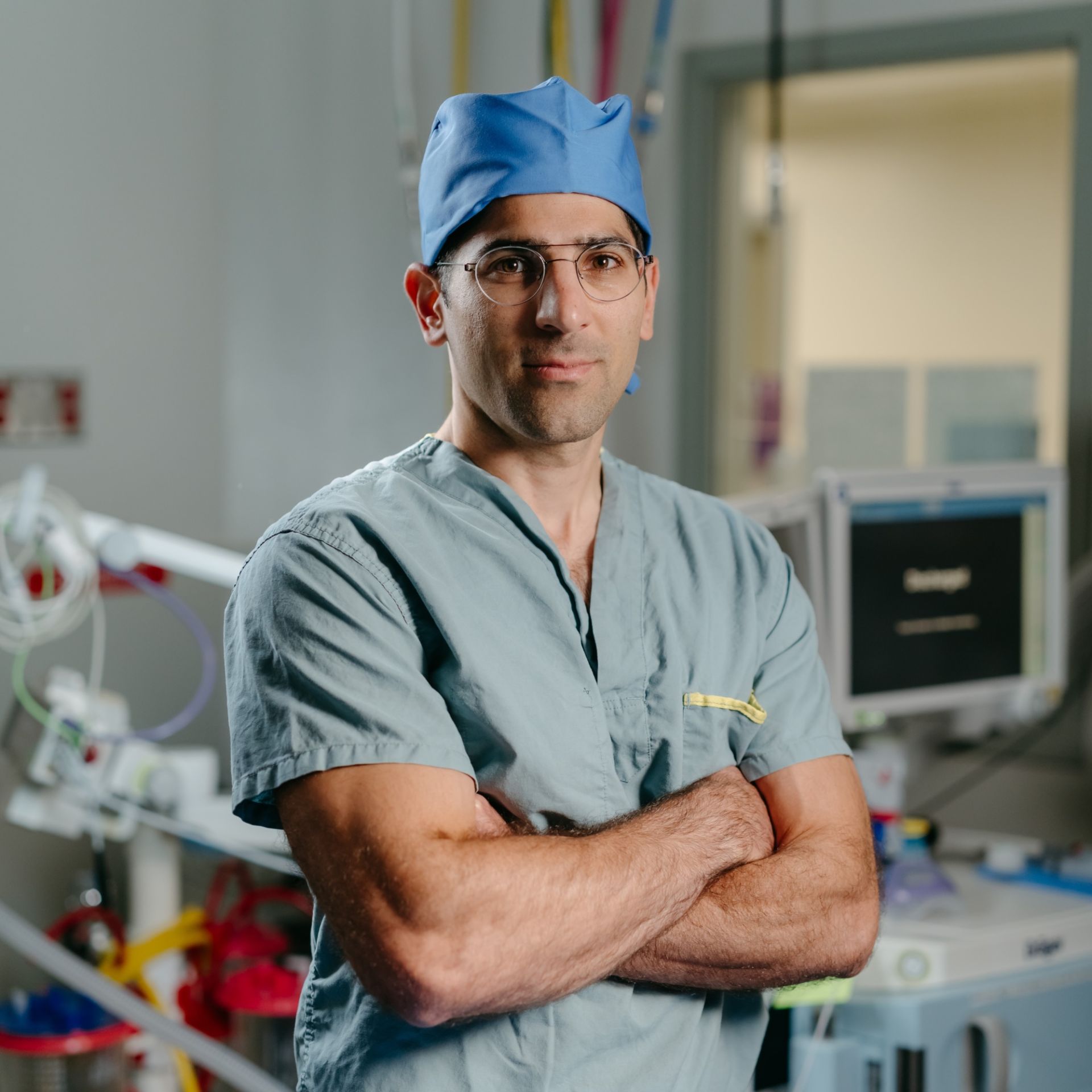
 It’s a great honour to write to part of my team.
And when I say my team, I mean the people who stand alongside my patients with me, who show up, lean in, and make bold things possible.
So much of what we can do in our operating rooms—how far we can advance care, how precisely we can operate, how many lives we change—happens through the work of the Foundation, and through the philanthropy of its donors: caring members of our community like you.
Donors believe. Donors help us evolve. And that has never mattered more than it does right now.
In British Columbia, cancer diagnoses are projected to rise by about 40 per cent over the next decade. That means more demand on our operating rooms, our care teams, and our hospital system; more need, and more Islanders—our families, our neighbours—who are coming face to face with a devasting diagnosis.
This reality is serious. But I write to you with confidence and tremendous hope too, because here in Victoria, we are incredibly fortunate. We have a community that refuses to simply keep pace with these statistics. Instead, we set the pace, and we lead. And you very much lead with us by equipping our operating rooms with the very latest tools to deliver care at the highest level.
It has honestly been a true honour to work alongside the Victoria Hospitals Foundation the last two years to define a wish list of surgical tools you would expect to find in the very best hospitals in Canada. Now when my patients face the devasting reality of a cancer diagnosis, I have more confidence in the care I can offer. And that means everything when cancer is involved.
Our Foundation has put surgeons in the driver’s seat, allowing us to drive bold change and design a brighter path through the It’s Time campaign. To do this in a universal healthcare system is truly unimaginable.
When my colleagues across the country ask me how we, in Victoria, have the best tools to treat complex and fast-growing cancers, including three robotic assisted suites that are revolutionizing how we work, I simply say: it’s because of donors.
It is only because of this partnership—only because of this community—that Victoria now leads on the national stage.
I wish to bring you into my world a little more. My specialty is colorectal cancer; cancers of the colon and rectum. These are cancers that can develop quietly, and sometimes they can be quite advanced by the time we find them. Colon cancer represents about 10% of all new cancer cases in Canada, and sadly it is the second‑leading cause of cancer‑related deaths.
What has changed in recent years is not only how many patients we are seeing, but who we are seeing.
We are now diagnosing colorectal cancer in people in their 20s and 30s—young parents, leaders in our community, athletes—people in the prime of their lives like my patient, Shaveeta, who was diagnosed at just 32 years old.
So yes, we’re seeing younger patients, and more patients. But we’re also doing procedures today that were out of reach for us not long ago. At times, before this campaign, we had to sit with patients and say, “We can’t do this now” or “We can’t do this here.” because the cancer was too advanced or because a patient wasn’t healthy enough for a large, open operation.
Very very often, the limiting factor wasn’t our skill or our will—it was the technology available to us. That’s a hard reality for many surgeons, and we were forced into impossible decisions.
Through the It’s Time For Surgical Evolution campaign, donors are helping to fund 60 new oncology tools that will push surgical cancer care across Vancouver Island even further, and helping me not have to make those decisions. I can’t express how grateful I am for that.
There has been deep intention behind both why and how these tools were selected. Surgeons from many specialties were at the table with the Foundation. We approached this the same way we approach care in the operating room: collaboratively, across specialties, as one team.
Let me bring that to life with a few examples. First, we requested additional advanced surgical towers to update from current high definition to 4K definition, which gives us four times the detail and dramatically sharper visualization.
In cancer surgery, what we can see matters enormously. When we operate for colorectal cancer, our goal is very clear: remove the cancer completely, while preserving as much function and quality of life as possible. We work in one of the tightest spaces in the body—the pelvis—where nerves, blood vessels, and vital structures sit just millimetres apart.
Advanced 4K surgical towers help reduce some of the most serious risks we worry about in cancer surgery. That means fewer leaks at surgical joints, lower infection rates, shorter hospital stays, and lower likelihood for repeat operations.
Second, we asked for SPY-PHY technology. One of the most critical moments in colorectal surgery is reconnecting the bowel. Whether that connection heals depends entirely on blood flow. SPY-PHY allows us to see that blood flow in real time, right in the operating room—guiding decisions on the spot and reducing the risk of complications including leaks or infection.
This matters deeply, because we know that when complications occur after cancer surgery, the risk of cancer recurrence increases. When technology helps us reduce those complications, it can also help reduce the chance of the cancer coming back.
A third example I will share is a new endoscopy system. Not long ago, we had only one advanced endoscopy tower. Because Victoria General serves both pediatric and adult patients, general surgeons and pediatric surgeons had to really balance equipment needs during surgeries and it was complex. We were often put in the impossible position of deciding who got access on what day. Now, with the new advanced Endoscopy System housed in an upgraded, fully integrated space, we will finally have the infrastructure our teams and patients deserve.
It will remove the need to switch systems mid‑procedure, and allow more patients to be treated. This will reduce wait times, and this will reduce surgical times for both adults and children.
These examples are just three of over 60 equipment pieces. What does all this technology ultimately mean? Safer surgery, faster access to care, and more patients receiving advanced treatment here at home. Not privately, not off the Island. Right here. So when someone on Vancouver Island has a stronger chance at a cure—that is because of donors like you.
I want to leave you with this: I came to Victoria six years ago after working at St. Paul’s Hospital in Vancouver, one of the leading colorectal centres in Canada. I can tell you honestly, what we are doing here now places Victoria among the most advanced cancer surgery programs. We are leading, certainly in western Canada and across the country.
And so, I thank you for believing in innovation and the campaign we have designed; what we can now do here in Victoria is extraordinary.