

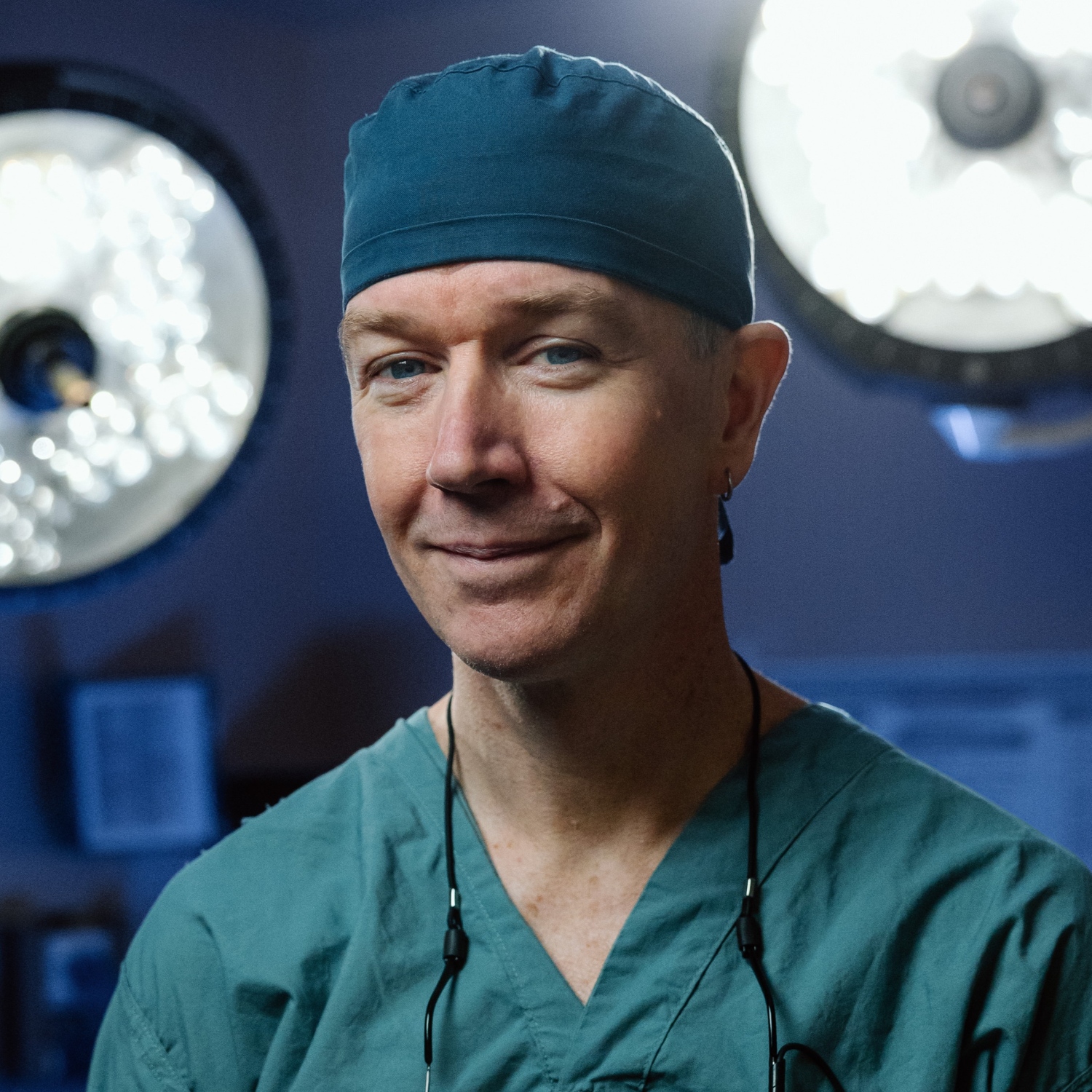
Dr. Matt Robinson, Head of Vascular Surgery for Island Health, leads a team of five vascular surgeons at Island Health, all here in Victoria. After completing his General Surgery training at UBC, Dr. Robinson pursued advanced specialty training in Vascular Surgery and has built a career focused on improving care for patients with complex vascular conditions. Since joining Island Health in 2012, he has been a strong advocate for innovation in surgical care. He constantly promotes what he likes to call “our little big town” and is well known to champion Victoria’s community with colleagues across Canada.
His leadership extends nationally through previous service with the Canadian Society of Vascular Surgery and, since 2019, on committees with the Royal College of Physicians and Surgeons of Canada. These roles have provided valuable insight into vascular care across the country while helping inform innovation here at home.
What is Vascular Surgery?
Vascular Surgery involves the medical, surgical, and interventional treatment of the arteries and veins throughout the body. It is a specialty covering a broad spectrum of medical conditions, and often involves collaboration with our colleagues in other surgical and interventional disciplines.
Sometimes an artery becomes severely narrowed or blocked, which depending on the artery involved can put someone at risk of stroke or threaten the blood supply to their leg. Sometimes the wall of an artery weakens and starts to enlarge, creating a large bulge or aneurysm that can become life-threatening if it ruptures. Common conditions that we treat include carotid disease which can lead to stroke, aortic aneurysmal disease which can lead to rupture and death, and peripheral arterial disease in the legs which can lead to limb loss and amputation.
As vascular surgeons, we also collaborate with our surgical oncology colleagues, helping to enable complex surgical resections of tumours and vascular reconstructions when cancer invades or involves major blood vessels supplying vital organs.
We also lend our expertise to trauma surgery, helping to correct life-threatening bleeding and restore blood flow to injured organs.
Our patients often have multiple other important medical conditions, and our therapies are tailored to balance the risks involved with treatment. Over the last thirty years, vascular surgery has been at the forefront of innovation, developing minimally invasive approaches to conditions that previously involved major open surgery, with large incisions and lengthy hospital stays. This is particularly true for aortic aneurysms, where treatment for many of our patients has gone from a large abdominal incision and seven days in hospital to tiny needle pokes in the groin and same day discharge.
These advances have spread to everything that we treat. We evaluate each situation based on the anatomy involved, and the technological options available to us. Most important to a vascular surgeon is the individual that we have in front of us, their medical history, and customizing a treatment plan that puts them first.
We are not limited by any single approach, and we fluidly shift between traditional open techniques involving incisions to gain access to treat blood vessels, and endovascular or “within the blood vessel” techniques. With endovascular approaches, we have advanced percutaneous or “incisionless” endovascular procedures working through the inside of blood vessels with tiny wires and stents, using x-ray imaging to guide us.
This mindset has led to vascular surgeons commonly using a “hybrid approach” to complex problems, using minimally invasive endovascular techniques working from within the blood vessel where the situation allows, and using incisions and traditional surgical techniques when the situation demands it.
Why is that becoming so important on Vancouver Island?
Our population is growing, aging, and it is also living well for longer, too. Every day, we’re seeing patients who are older, with more complex disease, and living with conditions that even a decade ago we might not have been able to treat.
We serve seven of the ten oldest communities in Canada. Vancouver Island represents about 15 per cent of B.C.’s population, but we do about 40 per cent of the province’s stroke care, so prevention matters enormously here.
For example, our Vascular Surgery team is doing over 250 carotid surgeries a year. The carotid arteries are the major arteries in your neck that carry blood to your brain. When plaque builds up and significantly narrows one of those arteries, that plaque can break loose, travel to the brain and cause a stroke.
These operations are about getting to that disease before that happens. We’re not treating the stroke after it has happened; we are preventing stroke and disability from happening in the first place. Sometimes we are alerted to a carotid narrowing after a mini-stroke; the goal is to urgently intervene before there is a repeat event that could be catastrophic.
Your team recently brought TCAR to Victoria. What is it?
TCAR is a minimally invasive approach to stroke prevention. Prevention is key for our population.
A stroke can happen when plaque in the carotid artery breaks loose and travels up into the brain. With TCAR, we make a small incision in the neck and temporarily reverse the direction of blood flow in that artery, sending it away from the brain while we treat the blockage. We then place a stent to open the artery, restore normal blood flow, and for the right patient, we’re sending them home in less than 24 hrs.
Our team performed the 10th through 14th TCARs in Canada. We’re one of only three centres in the country currently performing TCAR, and we’re fast becoming the highest-volume centre. That’s the kind of innovation our team continues to drive.
What else does a Vascular Surgeon treat?
Aortic aneurysms affect up to 5% of individuals over the age of 65. An aneurysm is a weakening in the wall of an artery. The danger is that it can grow without the patient knowing it’s there. If it ruptures, that becomes a life-threatening emergency.
We also treat patients who aren’t getting enough blood flow to their arms or legs. Sometimes this is due to other medical conditions, such as diabetes or atrial fibrillation.
Sometimes the need for intervention is very immediate. We recently cared for an 18-year-old woman after a rollover car accident up-Island. By the time she reached us, her arm had been without blood flow for nine hours.
In many circumstances, that type of injury can result in an amputation, but she’s 18 years old. She has her whole life ahead of her.
That’s Vascular Surgery, too. You’re trying to restore blood flow, save the limb and change what happens to that patient for the rest of their life. In her case, we were able to save her arm. She has a long road of recovery ahead of her, but she has that road ahead of her. And at 18, that means everything.
How will having two Hybrid Operating Rooms built at RJH change the work you do?
These are the first rooms of their kind on Vancouver Island. Importantly, we’re not converting two existing operating rooms (ORs) into Hybrid ORs. We’re adding two net-new ORs, the first since 2003.
A Hybrid OR is essentially a full operating room with very advanced, robotic-assisted imaging built right into it. That matters because it is increasingly how vascular surgery is being done. We may be working from inside the blood vessels using imaging, wires, catheters and stents. We may need to perform open surgery. And in some of our most complex cases, we need both.
In a Hybrid Operating Room, care comes to the patient.
For the really complex cases, that can mean a dozen caregivers in the room, along with all of the surgical and imaging technology they need, working around one patient.
Right now, we bring all of that together as best we can in a conventional operating room. A Hybrid OR is actually built for that kind of care—and it’s about twice the size as our current operating rooms.
The imaging is there. The technology is there. The ability to perform open surgery is there. The patient stays where they are, and the care comes to them.
That’s a significant change for us. And because these are two additional operating rooms, we’re not just changing what we’re capable of doing. We’re adding capacity at the same time.
Why is the imaging itself so important?
So much of modern vascular surgery now happens inside the blood vessels—what we call endovascular surgery—and that means imaging is everything.
If I’m putting in a stent, repairing an aneurysm or navigating through an artery, I need to know exactly where I am, where I’m going and what I’ve accomplished. The better the imaging, the more precisely we can work and, ultimately, the more complex the cases we can take on.
And honestly, I think about my team, too. They spend their careers standing beside this equipment, day after day. If we can reduce their radiation exposure significantly while giving them better imaging to care for patients, that matters enormously.
What could having Hybrid ORs allow Victoria to do?
We’re already doing some very sophisticated surgery here.
Our local teams are performing procedures that were once limited to institutions like Mayo Clinic, Stanford and Cleveland Clinic. We’re relatively small hospitals, but we’ve developed this incredible ability to punch above our weight.
That’s important for local patients. You shouldn’t have to leave Vancouver Island to access the frontiers of modern care. Increasingly, you don’t.
But we also need the capacity to keep doing it. Our population is growing and aging, the patients we’re seeing are more complex, and these two net-new operating rooms will increase our ability to take on these increasing needs.
There’s another piece to this, too, and that’s our people.
If we want to recruit exceptional physicians and nurses to Vancouver Island and, just as importantly, keep the exceptional people we already have, we need to give them an environment where they can practice at the top of their field. People want to work somewhere they can keep learning, innovating and pushing medicine forward.
We already have tremendous expertise here. Hybrid Operating Rooms give those teams the environment to take it further, while helping us attract the next generation of physicians, nurses and technologists who want to be part of that kind of program.
To me, that’s the bigger opportunity. It’s capacity. It’s recruitment and retention. And it’s making sure that the expertise we’ve worked so hard to build here can continue to grow.
Why should our community be excited about this phase, It’s Time for Surgical Transformation?
We are giving more options to Island patients. Sometimes that means preventing the stroke rather than treating it after it happens. Sometimes it means repairing an aneurysm before it ruptures. Sometimes it means saving an 18-year-old’s arm after nine hours without blood flow.
The expertise is already here. We have physicians, nurses and teams doing very sophisticated medicine. They’re pioneering new approaches, taking on increasingly complex cases and continually asking, “What else could we do for this patient?”
What this phase does is allow the environments around them to catch up with that ambition. It gives us more capacity. It gives us better imaging and technology. It gives us rooms built for the way modern surgery is actually being done, and for where it is going next. That idea of giving physicians the advanced environments to expand minimally invasive care and keep pushing what is possible was central to the It’s Time campaign framing.
From the bottom of my heart, I do want to thank our donors, because none of this happens without them. Our community has continually allowed us to ask a bigger question, not simply “What can we do with what we have?” but “What is the best care we could provide for this patient, and what would it take to do that here?”
Then our donors step forward and help us build it—that’s pretty special.
I think that’s why people should be excited: we’re not trying to become something we’re not; we’re building on something extraordinary that is already happening here, and giving it room to go further.