

Two brothers came from Iran as teens. Now they operate on cancer patients in Victoria
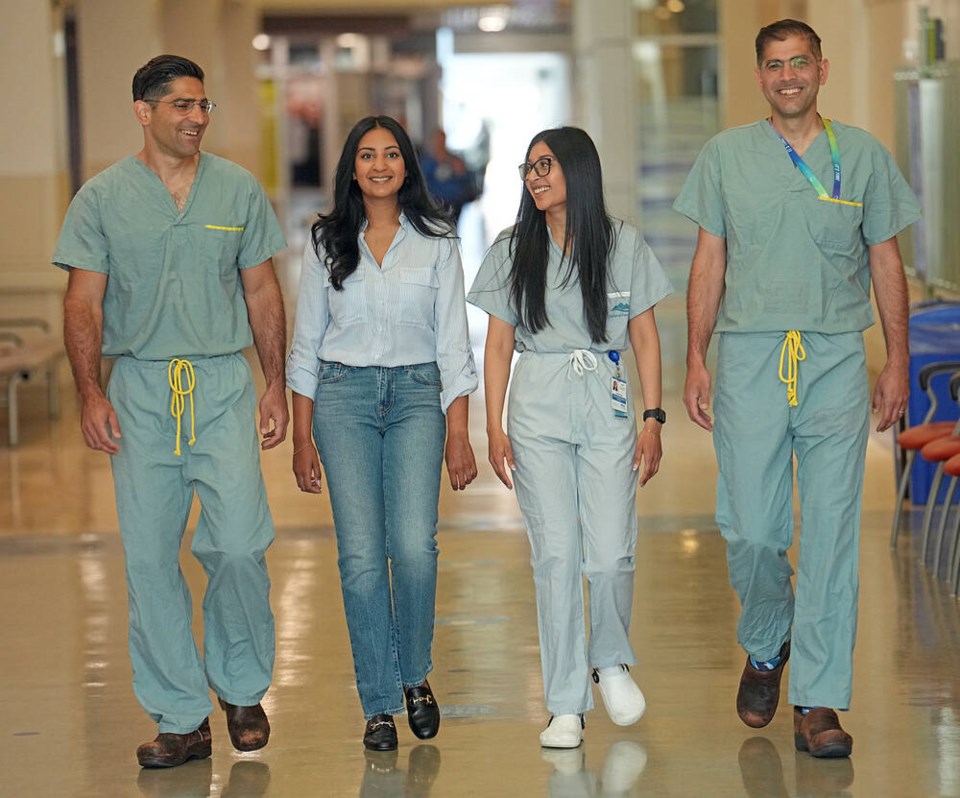
From left, Dr. Sepehr Khorasani, Shaveeta Jnagal, sister Raveena Jnagal and Dr. Mohammadali (Sohrab) Khorasani in a hallway at Royal Jubilee Hospital.
When Victoria’s Shaveeta Jnagal was diagnosed with colorectal cancer at age 32, everyone told her she was at least fortunate to have Dr. Khorasani assigned to her case.
“I’d tell people my surgeon was Dr. Khorasani, and they’d say: ‘You’re so lucky, he’s the best!’ ”
“Then they’d ask: ‘Which brother do you have?’ ”
“I was like: ‘What, there’s brothers? Surgeon brothers? In the same hospitals? That’s crazy!’ ”
It turned out her physician was Dr. Sepehr Khorasani, who specializes in colorectal surgeries, as opposed to Dr. Mohammadali (Sohrab) Khorasani, a surgical oncologist. The two cross paths, even doing surgeries together, in oncology cases.
Shaveeta’s cancer journey actually began at around age 19 with ulcerative colitis, a chronic autoimmune disease where the body attacks its own colon, causing constant inflammation and ulcers on the inner lining of the large intestine.
Young, embarrassed about her condition, and culturally unaccustomed to talking about things such as bowel disease, she suffered for months, progressively losing weight until one day in 2010 she had trouble breathing.
“My heart is hurting,” she told her mother. “We need to go to the hospital.”
Blood clots had travelled up to Shaveeta’s lungs. “I was told that if I had arrived even an hour later, I wouldn’t have survived,” she said.

Thus began a chapter of regular checkups with a gastroenterologist, medications and colorectal screenings.
Fourteen years later, she was undergoing a routine colonoscopy at Victoria General Hospital when she sensed from the physician’s demeanour that this particular screening result was anything but routine.
Ten days later, it was confirmed: colorectal cancer caused by her ulcerative colitis.
Told by her physician, she initially had an “out-of-body” experience, followed by shocked silence.
The audible cries only followed when she said the word “cancer” in a phone call to her sister, whom she immediately appointed “CEO of everything” — family liaison, organizer, caregiver and confidant — to shield her parents.
Ultimately, she made the tough decision to have her colon completely removed, replacing it with a permanent ostomy bag, rather than preserving part of it and continuing to have ulcerative colitis and the risk of the cancer returning.
Entering surgery, she said she had a sense of calm and absolute faith in her surgeon. “He was wearing a Superman scrub cap, and honestly, that is how I still see him: my Superman,” said Shaveeta.
Sepehr performed the six-hour procedure at Royal Jubilee Hospital. Afterwards, Shaveeta awoke to see her sister Raveena, then 29, a nurse, who stayed by her side day and night for the next seven days of recovery in hospital.
“She would come and spend the night, she would help me get ready for bed, and give me a sponge bath, and brush my teeth, and brush my hair — all the things — and she’d get me into a new gown,” said Shaveeta.
Looking at her once-strong physique in the hospital bathroom mirror, tubes and an ostomy bag hanging from her weakened core, was an adjustment, she said.
She still had chemotherapy treatments ahead to kill the cancer that had spread beyond her colon.
“If I was by myself, I probably would have just cried, but because Raveena was with me, I remember looking at myself for the first time, and I just started hysterically laughing,” she said.
“We both just started laughing, because there’s only so much you can cry.”
‘Whatever we did, we did it together’
Sepehr and Sohrab Khorasani were 16 and 18 and able to speak very little English when they left Isfahan, Iran, in 2002 for Canada, which their father saw as the ideal country to raise a family, given its opportunities and multiculturalism.
Their dad, now 72, was an architect who had studied in the United States and taught in the city’s university, while their mother, now 65, was a university-educated artist.
“They decided to put their careers aside, and their families and lives aside, and brought us over,” said Sohrab, noting the family quickly “made Canada home.”
The teen boys had played competitive tennis and soccer in Iran and carried that love of sports to Vancouver, where they both played at a provincial and national level.
“Whatever we did, we did it together,” said Sepehr, 40, who is often assumed to be his brother’s twin. “We were a source of motivation for each other. We basically were considered as one person everywhere we were going.”
Sepehr, who had been interested in anatomy, dissection and medicine since childhood, studied sciences at the University of B.C.
And Sohrab, who loved math and physics, attended Simon Fraser University, focused on a future in electrical engineering until he was drawn to medicine through related work in biomedical engineering — work that linked technology to patient care.
The two ended up applying the same year to UBC’s medical school, said Sohrab, now 42. They were thrilled to attend their chosen institution in Vancouver and to stay close to their community, where their parents, whom they still visit every other weekend, remain today.
Once they graduated from medical school, they talked to UBC staff and faculty about the chances of both brothers also getting into UBC’s specialty program in general surgery, and were told: “That’s impossible. That’s never going to happen,’ ” Sepehr said.
On the day medical graduates are matched with a hospital and specialty for their residency, however, “We get the invitation, both of us got in, which was very exciting for us,” said Sepehr.
“I remember the program director actually emailed us and said: ‘We got the Sedin twins!’ ” — a reference to the sibling Vancouver Canucks’ hockey players, since retired.
The Khorasani brothers spent four years in the same class in medical school, five years together in general surgery residency at UBC, and two years in sub-specialty fellowship training at the University of Toronto, where Sepehr focused on colorectal surgery and Sohrab on surgical oncology. They both completed their training in 2019.
Afterwards, Sohrab came to Island Health while Sepehr went to St. Paul’s Hospital in Vancouver, a designated Center of Excellence for colorectal surgery and gastrointestinal care, according to Providence Health Care.
The next year, in 2020, Island Health successfully lured Sepehr to practice alongside his brother in Victoria.
The two brothers now work at the same Victoria hospitals —Royal Jubilee and Victoria General — with specialties that overlap in oncology, colon and rectal cancer surgeries.

‘We always had each other’s backs’
The pandemic years would test all health-care professionals, but coming out of that era was the promise of robotic-assisted equipment and a long wish-list of surgical tools and oncology technology as part of a massive fundraising campaign by the Victoria Hospitals Foundation.
Initial improvements included advanced surgical towers — wheeled stacked carts holding robotic extensions, 4K monitors, cameras and light sources — offering ultra-high-definition as well as near-infrared imaging that penetrates deep into tissues to identify critical structures and provide information on blood flow.
All this is enormously important in operating on complex colorectal cancers, said Sepehr.
In a letter on the foundation’s website, he noted that he and other colorectal surgeons in the field work in one of the tightest spaces in the body — the pelvis — where nerves, blood vessels, and vital structures sit just millimetres apart.
The fundraising campaign would also deliver two da Vinci robot-assisted surgical systems — one at Royal Jubilee Hospital for urology, ear-nose-throat, and thoracic procedures and a second at Victoria General Hospital used in gynecology, pediatrics, and general surgery — as well as a Mazor X neurosurgical robot for brain and spine surgeries at Victoria General.
The Khorasani brothers, with colleague Dr. Cailan McPherson, were sent to the United States last year to train in robot-assisted surgery, becoming the first general surgeons to use the technology in Victoria. They’ve had even more training since.
“I’ve been able to do four out of five gastrectomies this year, all on the robot,” said Sohrab, noting that a year of data on colon and rectal cancer surgeries shows the robot-assisted-procedure outcomes are on par with or better than previous methods.
Gastrectomy is a radical surgery of about four to five hours to remove the majority or all of the stomach and surrounding lymph nodes for treatment of advanced gastric cancer, said Sohrab, who specializes in intra-abdominal malignancies, rectal cancer, gastric cancer and sarcomas.
Stomach tumours are more routinely removed through open surgery and in selected cases, laparoscopically. When they’re done with robot-assisted surgical systems, patients are discharged in an average of three days compared to seven to 10 days with open surgery, he said.
The new equipment and training are allowing Victoria physicians to push cancer surgery further than ever before, said Sohrab. “We’re the second hospital in the whole of Canada who offers that [robot-assisted gastrectomy].”
Only a few highly specialized centres in Canada can successfully manage complex stomach cancer, as it requires “a big team” of different specialists, expertise and services. Victoria is not only one of those centres, but now has the robot.
Sepehr said the south Island’s colorectal surgical team is capable of caring for patients with almost any colorectal condition, from inflammatory bowel disease to malignancies, ensuring patients don’t have to travel to the Lower Mainland.
Sepehr was asked this summer to be one of the first proctors in Canada to demonstrate and teach robotic-assisted surgery in this country.
Sepehr, who earned a master’s degree in clinical epidemiology and health-care research during his fellowship in Toronto, said he and Sohrab keep busy researching, reading, attending conferences and training in new procedures, given the rapid advancements in cancer treatments.
The brothers are now in high demand — top in their respective fields, according to Jeff McCracken, chief urologist and head of robotics for Royal Jubilee and Victoria General hospitals.
While they see the need to contribute nationally and globally, Sohrab said they’re committed to giving back to B.C. and Canada, and to the donors who have helped the Victoria Hospitals Foundation supply Victoria General and Royal Jubilee with the latest technology.
“When you see a community like Victoria step up and provide the most recent technology for the surgeons to be able to do the job better, I really like this,” said Sohrab. “It is something that you don’t see in many other bigger centres.”
Sepehr said physicians endure a lot of moral stress when they don’t have the capacity or equipment to do what a patient might need to save their life.
Physicians want to feel that “the patient just got a service, or operation, or a cure that they probably couldn’t have gotten anywhere else in the world, or that they got care equivalent to what they could have gotten in best place in the world,” said Sepehr. “That really is a great feeling at the end of the day, to be honest.”
The brothers are eager to train the next generation of residents and medical students while continuing to collaborate with bigger centres, such as those in Toronto and Vancouver, on research.
They credit the deep desire they both feel to help others to their parents and their upbringing.
“They never once in our lifetime said: ‘You have to go to medicine, you have to do law, you have to become a successful person,’ ” said Sepehr.
“They provided the opportunities, and they let us choose. They’ve been so supportive and caring, and we owe everything that we have to them.”
Their relationship with each other is also a big part of their success, from the tennis court and soccer pitch to school and now hospitals, they say.
“We would go through medical school applications together, we would read each other’s essays, and once we got into med school, we would study together, we would go to a library together, we would bounce ideas off of each other, and then in residency the same thing,” said Sepehr, adding that if he’s ever stuck in a difficult case, he knows he has someone to call.
“Not everybody has that, and we realize that, and we’re so grateful to have that, because otherwise things would have been a lot more different for us,” he said.
In surgery, they can intuit each other’s movements and, as if in a surgical symphony, they can almost perform as each other’s hands.
“We won’t be where we are if we didn’t have each other,” said Sepehr. “We always had each other’s backs, like we were helping and supporting each other, and that really was instrumental.”

‘She’s helped me get through the darkest times’
As for Shaveeta, she feels equally lucky to call her sister Raveena, now 31, her best friend, as well as a remarkable nurse.
“She’s seen me now at my worst, and she’s helped me get through the darkest times,” she said. “She was my voice for a lot of the moments when I couldn’t talk about it. I don’t know how I would have gone through without her. Honestly, I don’t know how people do it without a sister like her.”
For her part, Raveena, who had been downplaying her sister’s concerns prior to diagnosis, said when she heard the word cancer, she instinctively put aside her “utter shock” and shifted into a combined nurse-sister mode.
“My training gave me the knowledge and confidence to recognize and assess how to respond, but at the heart of it, I was simply her sister [and] the thought of anything happening to her was terrifying,” said Raveena.
Watching her sister “walk through such a difficult chapter with so much positivity” taught her how to be a better sister, daughter, and friend, “but also a better nurse for others going through similar journeys,” she said.
Beyond medicine, science and surgical skills, feeling loved and understood “can play a powerful role in healing,” said Raveena.
This summer, Shaveeta and family travelled through Paris, London and Dublin for a family wedding. It involved a lot of sightseeing, walking, eating and feeling gratitude.

“I felt like the whole trip was a celebration of my renewed health,” said Shaveeta, who is now cancer-free at 35.
Prior to her diagnosis, Shaveeta said she was wearing “terrible prescription rose-colored glasses,” not really grasping the fragility of life or the gift of everyday blessings. Now those glasses are off and everything is “4K” clear, she said.
“The grass is greener, the sky is like beautiful blue, the wind is in my hair, and I can feel everything so vibrantly,” said Shaveeta.
“Life is just such a gift and such a privilege, and now my sense of that is even stronger because that was almost taken away from me.”